Benefits of Solving CLAT Previous Years’ Question Papers
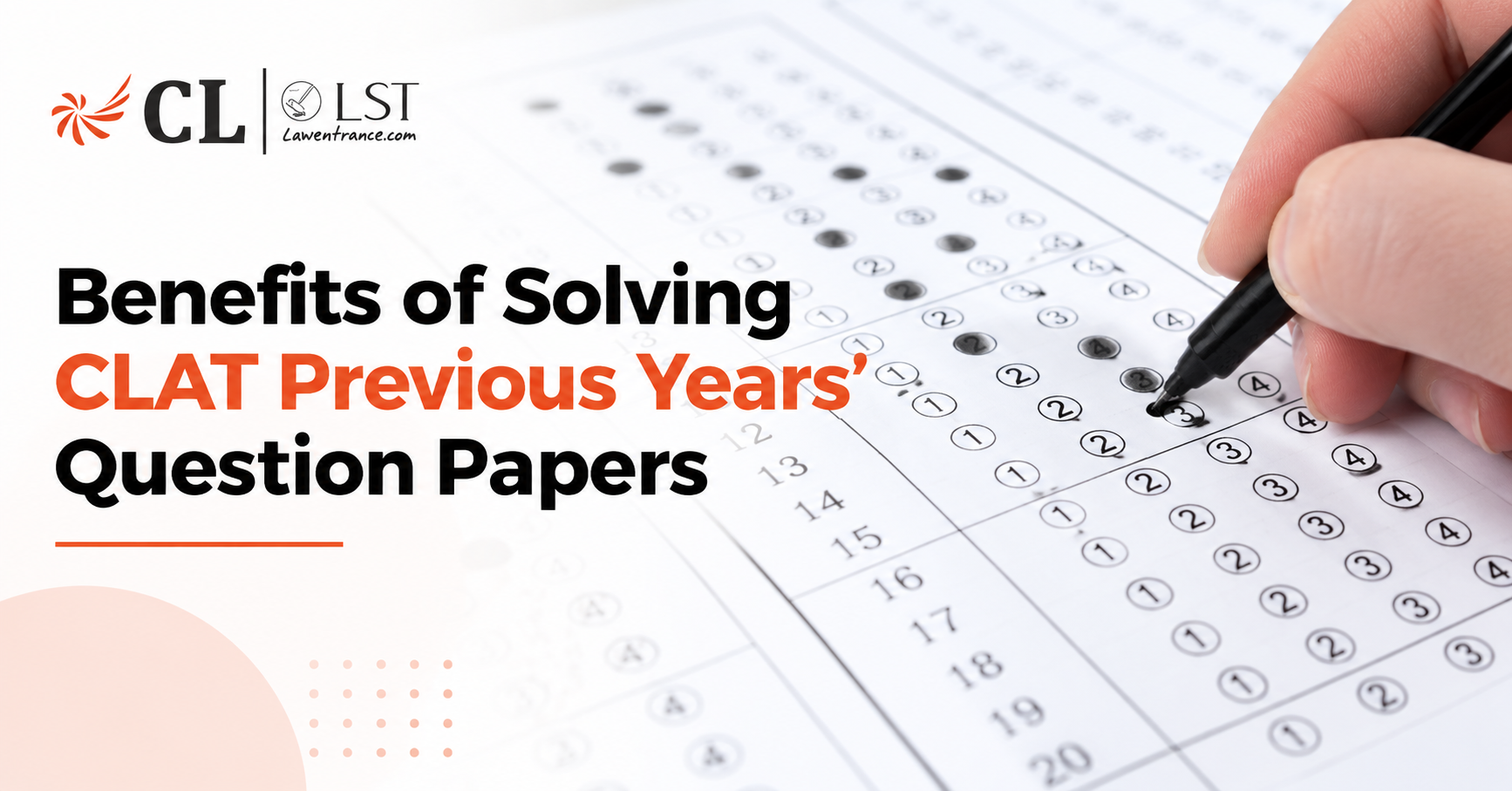
CLAT previous year question papers (PYQs) help students understand how questions are framed, what types of passages are asked, and the difficulty level of the examination. Solving papers from different years also helps students identify question trends, improve time management, and assess their preparation under exam-like conditions.
This blog covers the benefits of solving CLAT previous years’ question papers, how to use them effectively, and when to start solving them.
Table of Contents
Why Are CLAT Previous Year Question Papers Important?
There’s a real difference between knowing a concept and applying it under exam conditions. PYQs bridge that gap by exposing you to the kind of passages and questions CLAT actually asks. Solving papers from multiple years also helps you notice how question styles and difficulty have shifted over time.
Benefits of Solving CLAT Previous Years’ Question Papers
Understand the CLAT Exam Pattern
Working through PYQs builds familiarity with the paper’s structure and format, including passage-based questions across sections, so nothing feels unfamiliar on test day.
Identify Recurring Topics and Question Trends
Reviewing multiple years helps you spot recurring themes and the ways similar topics get tested, not to predict exact questions, but to prioritise your preparation.
Understand the Difficulty Level
PYQs give you a realistic sense of how tough actual questions are and how difficulty varies by section, since classroom-level questions often don’t match real exam difficulty.
Improve Speed and Time Management
Attempting papers within the prescribed time is one of the best ways to practise pacing, learning when to push through and when to move on, while building speed without losing accuracy.
Improve Accuracy
Consistent practice reduces avoidable errors and helps you handle close answer choices better, while encouraging careful reading before selecting a response.
Identify Strengths and Weak Areas
PYQs double as a diagnostic tool. Tracking section-wise performance helps you spot topics where mistakes repeat and questions that eat up time, so you can adjust your strategy.
Develop Better Question-Solving Strategies
Solving papers lets you experiment with when to attempt, skip, or return to a question, helping you build a personalized approach for lengthy passages.
Build Exam-Day Confidence
Repeated exposure to real papers reduces unfamiliarity, and practising under timed conditions makes the actual test feel more manageable as you see measurable improvement.
Learn From Mistakes
Checking your score alone isn’t enough to review every incorrect answer, and even questions you guessed right. Categorise errors (conceptual, comprehension, misinterpretation, calculation, time management) and keep an error log to avoid repeating them.
How to Use CLAT Previous Year Papers Effectively
Start section-wise and topic-wise. Once you’ve covered a section’s basics as outlined in the CLAT Syllabus, use PYQs to see how it’s tested, prioritising accuracy before adding time limits.
Move to full-length timed papers. Once comfortable, attempt complete papers in one sitting under the real time limit, without checking answers mid-attempt. This approach should be part of a broader CLAT Preparation Strategy that combines PYQs with revision, regular practice, and mock tests.
Analyse your performance after every paper.
| What to Analyse | What to Check |
| Accuracy | Number of correct and incorrect answers |
| Time | Sections or questions taking the most time |
| Mistakes | Reason behind incorrect answers |
| Guesses | Questions answered without certainty |
| Weak Areas | Topics requiring additional revision |
| Strategy | What worked and what needs to change |
Maintain an error log. Record recurring mistakes and the correct approach, and revisit it during revision to spot patterns.
When to Start Solving CLAT Previous Year Papers
There’s no single fixed timeline; it depends on your stage of preparation:
- At the beginning: Solve a few PYQs to understand the exam and question format.
- After completing basic concepts: Begin topic-wise and section-wise practice.
- During regular practice: Gradually increase timed questions and full sections.
- During intensive preparation: Attempt complete previous-year papers under exam conditions.
- Closer to the exam: Focus on recent papers, full-paper attempts, and analysis of recurring mistakes.
You can find a wide range of CLAT Previous Year Papers to practise with as you move through each of these stages.
Conclusion
CLAT previous year papers help you understand the exam pattern, identify trends, improve speed and accuracy, and assess your preparation. Solve, analyse your mistakes, and apply what you learn to make PYQs a valuable part of your CLAT preparation.
Suggested Readings
How to Manage CLAT 2028 Preparation?
Frequently Asked Questions
- When should students start solving CLAT previous year papers?
Start early for familiarization, then move to topic-wise practice, and finally full timed papers as the exam nears. - How Many Years of CLAT Previous Year Papers Should You Solve?
Ideally, solve CLAT previous year papers from 2024 onwards, as these follow the current 120-question format. - Are CLAT previous year papers enough for preparation?
No. Combine them with concept building, mock tests, and regular revision. - Are recent CLAT previous year papers more useful?
Recent papers reflect the current exam style best, though older papers still help with spotting broader trends. - Can solving CLAT PYQs improve accuracy?
Yes. Familiarity with question structures helps reduce avoidable errors and improves how you handle close answer choices.
Author

Popular Posts
MH-CET Law 2025 Cutoff(5-Year)Out: Check Past Year Trends, & More
By CL LST Team
27 May 2025 12507
CLAT 2026 Question Paper (Updated) – Download CLAT 2026 Question Paper PDF
By CL LST Team
09 Dec 2025 9748
![MH-CET Law 2025 Result OUT! [Direct Link to Score card]](https://www.lawentrance.com/blogs/wp-content/uploads/2025/06/ChatGPT-Image-Jun-5-2025-04_52_35-PM.png)
MH-CET Law 2025 Result OUT! [Direct Link to Score card]
By CL LST Team
05 Jun 2025 9190
MH CET Law Reservation Policy
By CL LST Team
31 Mar 2025 8107
Latest Posts

Repeaters & Droppers Strategy for CLAT Preparation
By CL LST Team
16 Sep 2026 41
Benefits of Solving CLAT Previous Years’ Question Papers
By CL LST Team
16 Sep 2026 35

How to Score 20+ in Logical Reasoning for CLAT 2027?
By CL LST Team
15 Sep 2026 45
90 Days Preparation Strategy for SLAT 2027
By CL LST Team
14 Sep 2026 38