How to Manage CLAT 2028 Preparation in Class 11: A Practical Guide

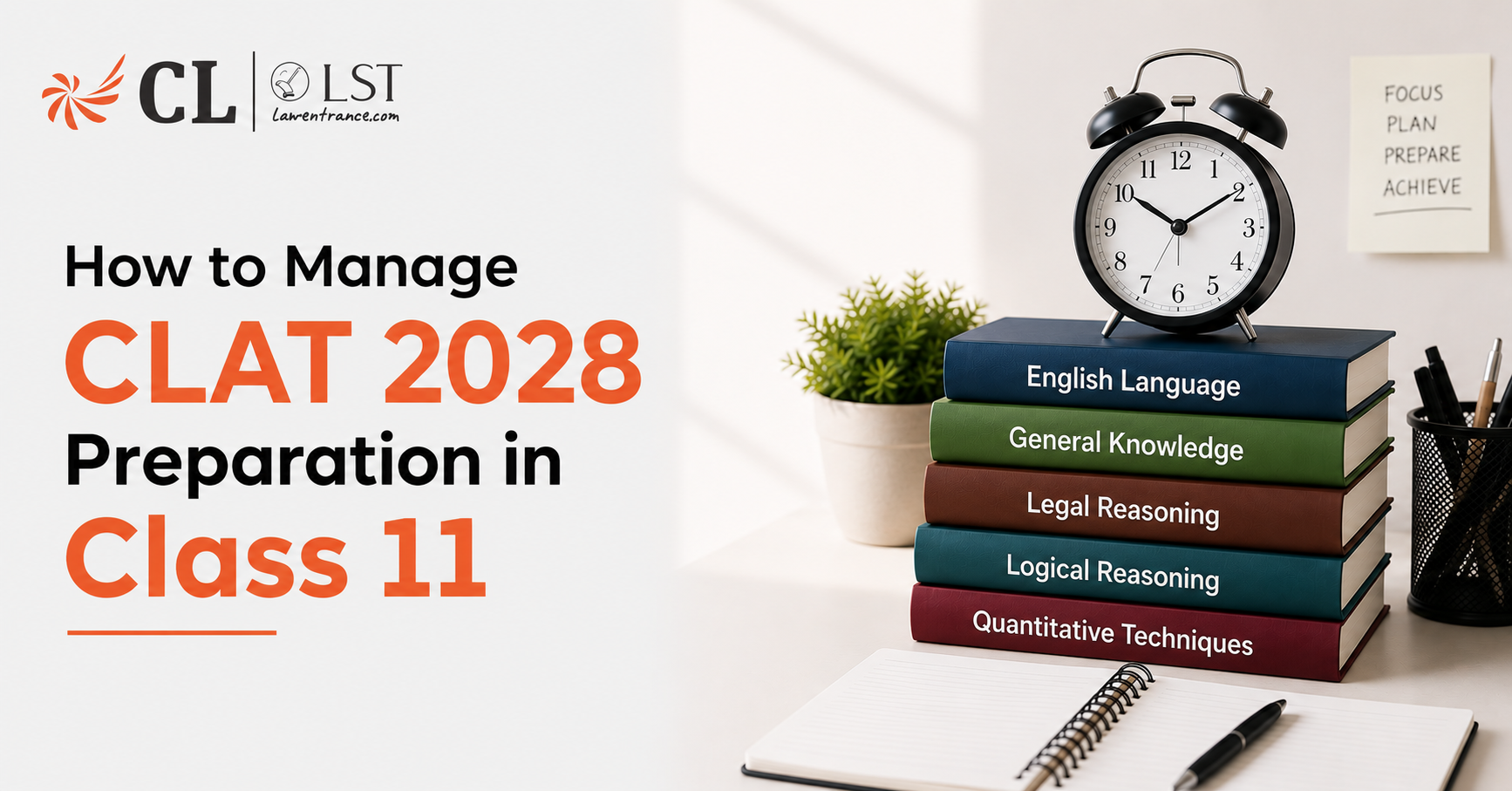
If you’re in Class 11 and thinking about CLAT 2028, you’re ahead of most aspirants already. While many students start preparing in Class 12, you have close to a year and a half in hand, which is enough time to build skills instead of rushing through last-minute prep.
The key is knowing how to use that time well, alongside your school studies. This guide walks you through exactly how: what CLAT actually tests, how to split your preparation into simple phases, what to focus on in each section, and the mistakes to watch out for along the way.
Table of Contents
CLAT Exam Overview
CLAT, the Common Law Admission Test, is conducted once a year by the Consortium of National Law Universities for admission to five-year integrated law programmes at NLUs across India. It’s held in offline, pen-and-paper mode.
Based on the CLAT exam pattern observed over the past year’s papers, the exam lasts 2 hours and comprises 120 multiple-choice questions across five sections. Each correct answer gets you 1 mark, and every wrong answer costs 0.25 marks.
| Section | Approx. Questions | Weightage |
| English Language | 22-26 | ~20% |
| Current Affairs & GK | 28-32 | ~25% |
| Legal Reasoning | 28-32 | ~25% |
| Logical Reasoning | 22-26 | ~20% |
| Quantitative Techniques | 10-14 | ~10% |
How to Start CLAT 2028 Preparation in Class 11: Phase-Wise Plan
Don’t try to study everything at once. Break your preparation into phases, each with a different focus, so it builds up rather than feels scattered.
| Phase | Timeline | Focus |
| Phase 1: Foundation | Oct 2026 – Mar 2027 | Reading Habit, Vocabulary, Basic Legal Awareness, NCERT Maths Revision |
| Phase 2: Skill Building | Apr 2027 – Aug 2027 | Subject-Wise Practice, Sectional Tests |
| Phase 3: Mocks & Revision | Sep 2027 – Nov 2027 | Full-length Mocks, Error Analysis, Closing Weak Areas |
| Final Stretch | Last 2-3 weeks before the exam | Light Revision, No New Topics, Exam-Day Preparation |
Phase 1: Foundation (Oct 2026 – Mar 2027)
In this phase, you have to focus on building the basics: a daily reading habit, vocabulary, and general awareness of legal concepts. There’s no need to attempt CLAT-level questions yet. The goal is to get comfortable with the kind of reading and thinking the exam is built around.
- Read the newspaper (Editorial + Front Page) daily, 30-45 minutes.
- Learn 5-10 new words a day.
- Read one legal awareness article, 3 times a week.
- Solve basic reasoning puzzles, 3 times a week.
- Revise Class 9-10 NCERT Maths over this phase.
Phase 2: Skill Building (Apr 2027 – Aug 2027)
In this phase, you have to move from habit-building to actual subject-wise practice. Cover each section of the CLAT syllabus one by one, and give more time to Legal Reasoning and Current Affairs, since these two carry the highest weightage in the exam.
- Practice CLAT-pattern English passages, 3 times a week.
- Solve Legal Reasoning questions (case-based), 3 times a week, since this section carries the most weightage.
- Practice Logical Reasoning sets, 3 times a week.
- Practice Quantitative Techniques weekly: percentages, ratios, averages, profit-loss, data interpretation.
- Take your first sectional tests toward the end of this phase.
By the end of Phase 2, you’ll know which sections come easily and which need more work.
Phase 3: Mocks and Revision (Sep 2027 – Nov 2027)
In this phase, you have to shift from learning to testing. Stop picking up new topics and focus on full-length mock tests, careful analysis, and revising whatever the mocks show is still weak.
- Take one full-length mock every week, moving to two a week in November.
- Spend at least as much time analysing a mock as you did attempting it.
- Revise weak sections identified in Phase 2.
- Track repeated mistakes; a pattern in Legal Reasoning errors, for instance, needs fixing, not just review.
By the time Class 11 ends, you should have already built the reading stamina and reasoning skills the exam demands. Class 12 then becomes about sharpening speed and accuracy, not starting from zero.
Also Check: CLAT Previous Year Papers | Free Mock Test
Final stretch (Last 2-3 Weeks)
In this phase, you have to stick to revision only. Avoid starting new topics at this stage, since it usually causes more confusion than benefit so close to the exam.
- Revise your existing notes instead of picking up new topics.
- Attempt one or two light mocks to stay in rhythm, without over-testing yourself.
- Sort out admit card, exam centre details, and required documents in advance.
- Get proper sleep in the final days rather than pushing extra study hours.
School still comes first through all three phases. Keep CLAT prep to a fixed evening slot, 60-90 minutes on school days, and use weekends for mocks and revision. During school exam weeks, drop down to light reading and pick full prep back up once exams are done.
If you’d rather follow this kind of structured, phase-wise plan with someone tracking your progress, CLAT Online Coaching is built around this exact approach, with scheduled mocks and subject-wise support.
Section-wise CLAT 2028 Preparation Strategy
Below is the section wise strategy:
English Language (~20% weightage)
The English section is entirely passage-based. You’re tested on inference, tone, the author’s intent, and vocabulary in context, not isolated grammar rules.
- Read 1-2 editorials daily and question the author’s argument as you go.
- Practice 1-2 CLAT-style comprehension passages under timed conditions once you reach Phase 2.
- Keep a vocabulary notebook based on context, not dictionary definitions.
- Word Power Made Easy by Norman Lewis is a solid reference for building vocabulary gradually.
Current Affairs and General Knowledge (~25% weightage)
This section is issue-based, not trivia. It tests whether you understand an event, not just whether you remember it happened.
- Read a daily newspaper for 30-45 minutes, focusing on national and legal news.
- Keep short notes on constitutional amendments, government schemes, and landmark court judgments.
- Revise the monthly compendium regularly, instead of trying to cover everything in the final weeks.
Legal Reasoning (~25% weightage)
This is the highest-weightage section along with Current Affairs, and the good news is you don’t need any prior legal knowledge. Each question gives you a legal principle and a fact scenario, and you apply one to the other.
- Practice previous years’ CLAT Legal Reasoning passages regularly from Phase 2 onward.
- Learn to identify the principle, the exception, and how it applies, rather than memorising laws.
- Answer only from what the passage states; don’t bring in outside legal knowledge.
Logical Reasoning (~20% weightage)
This section tests critical thinking through passages, not standalone puzzles. You’re assessed on spotting assumptions, drawing conclusions, and evaluating arguments.
- Practice argument-based questions: assumptions, conclusions, strengthening and weakening arguments.
- Add analytical puzzles (seating arrangements, blood relations) for variety.
- Dedicate 15-30 minutes daily to critical reasoning practice.
Quantitative Techniques (~10% weightage)
This section covers Class 10 level maths: percentages, ratios, averages, profit-loss, time-speed-distance, and data interpretation. No calculus, no trigonometry.
- Revise Class 9-10 NCERT Maths thoroughly.
- Practice data interpretation from past CLAT papers.
- Aim for full accuracy over speed; with only 10-14 questions, the negative marking here adds up fast.
- A short weekly session is enough given the lower weightage.
Common Mistakes CLAT 2028 Aspirants Make
- Skipping the foundation phase: Jumping straight into mocks without building reading speed and basic reasoning first leads to guesswork, not real problem-solving. Phase 1 exists for a reason; don’t rush past it.
- Studying at random hours: An hour today, three hours next week, nothing the week after. A fixed daily slot is what actually survives two years of school alongside CLAT prep.
- Not analysing mock tests properly: Attempting 30 mocks without reviewing your mistakes is practice without progress. The analysis is where the actual improvement happens, not the attempt.
- Letting Current Affairs slide: This section carries close to 25% weightage, and it’s the easiest one to fall behind on. Missing even a month of daily news reading creates a gap that takes weeks to close.
- Over-preparing for Quant, under-preparing for Legal Reasoning: Quant is only 10% of the paper. Spending equal time here and on Legal Reasoning, which carries 25%, is time poorly spent.
- Guessing blindly on tough questions: With -0.25 for every wrong answer, random guessing costs more than it earns. Attempt a question only if you can rule out at least one option first.
Also Read: Is CLAT only for English Medium Students
Conclusion
Balancing CLAT 2028 with Class 11 isn’t about putting in more hours. It’s about understanding the exam, working through it in phases, and giving each section the time its weightage deserves. Do that consistently through Class 11, and Class 12 becomes about refining what’s already in place, not building it from scratch.
Also Check: Is it too Early for CLAT 2028?

Frequently Asked Questions
Q: When is the CLAT 2028 Exam?
A: The Consortium of NLUs hasn’t released the official notification yet. Based on the pattern of the last few years, the exam will be conducted in the first week of December 2027.
Q: Will the CLAT 2028 exam pattern change?
A: It’s possible. An Expert Committee headed by Justice Indu Malhotra has proposed cutting CLAT UG down to three sections, dropping GK and Current Affairs, and merging Legal with Logical Reasoning. These changes weren’t applied to CLAT 2027, and the Consortium hasn’t confirmed them for CLAT 2028 yet, so it’s best to prepare on the current five-section pattern for now.
Q: How many months of preparation are required for CLAT 2028?
A: Starting in Class 11 gives you close to a year and a half before the exam. That’s more time than most aspirants get, so the focus should be on steady, phase-wise preparation rather than rushing through everything at once.
Q: Can I crack CLAT 2028 without any legal background?
A: Yes. Legal Reasoning questions give you the legal principle within the passage itself, so you’re applying it to a scenario, not recalling something you studied separately. No prior knowledge of law is required.
Q: Which newspapers should I read for CLAT 2028 preparation?
A: The Hindu and The Indian Express are commonly used for CLAT prep, mainly for their editorial sections and national and legal news coverage.
Author

Popular Posts
MH-CET Law 2025 Cutoff(5-Year)Out: Check Past Year Trends, & More
By CL LST Team
27 May 2025 12559
CLAT 2026 Question Paper (Updated) – Download CLAT 2026 Question Paper PDF
By CL LST Team
09 Dec 2025 10222
![MH-CET Law 2025 Result OUT! [Direct Link to Score card]](https://www.lawentrance.com/blogs/wp-content/uploads/2025/06/ChatGPT-Image-Jun-5-2025-04_52_35-PM.png)
MH-CET Law 2025 Result OUT! [Direct Link to Score card]
By CL LST Team
05 Jun 2025 9247
MH CET Law Reservation Policy
By CL LST Team
31 Mar 2025 8186
Latest Posts

Protecting Childhood or Restricting Liberty? The Constitutional Limits of Age-Based Social Media Regulation in India
By CL LST Team
23 Oct 2026 14
CLAT 2027 Last 30 Days Strategy to Maximize Your Score
By CL LST Team
16 Oct 2026 82
CLAT 2027 Answer Key: Expected Release Date, PDF Download, and Objection Process
By CL LST Team
14 Oct 2026 102
SLAT Results 2027: Date, Scorecard and Merit List
By CL LST Team
13 Oct 2026 75