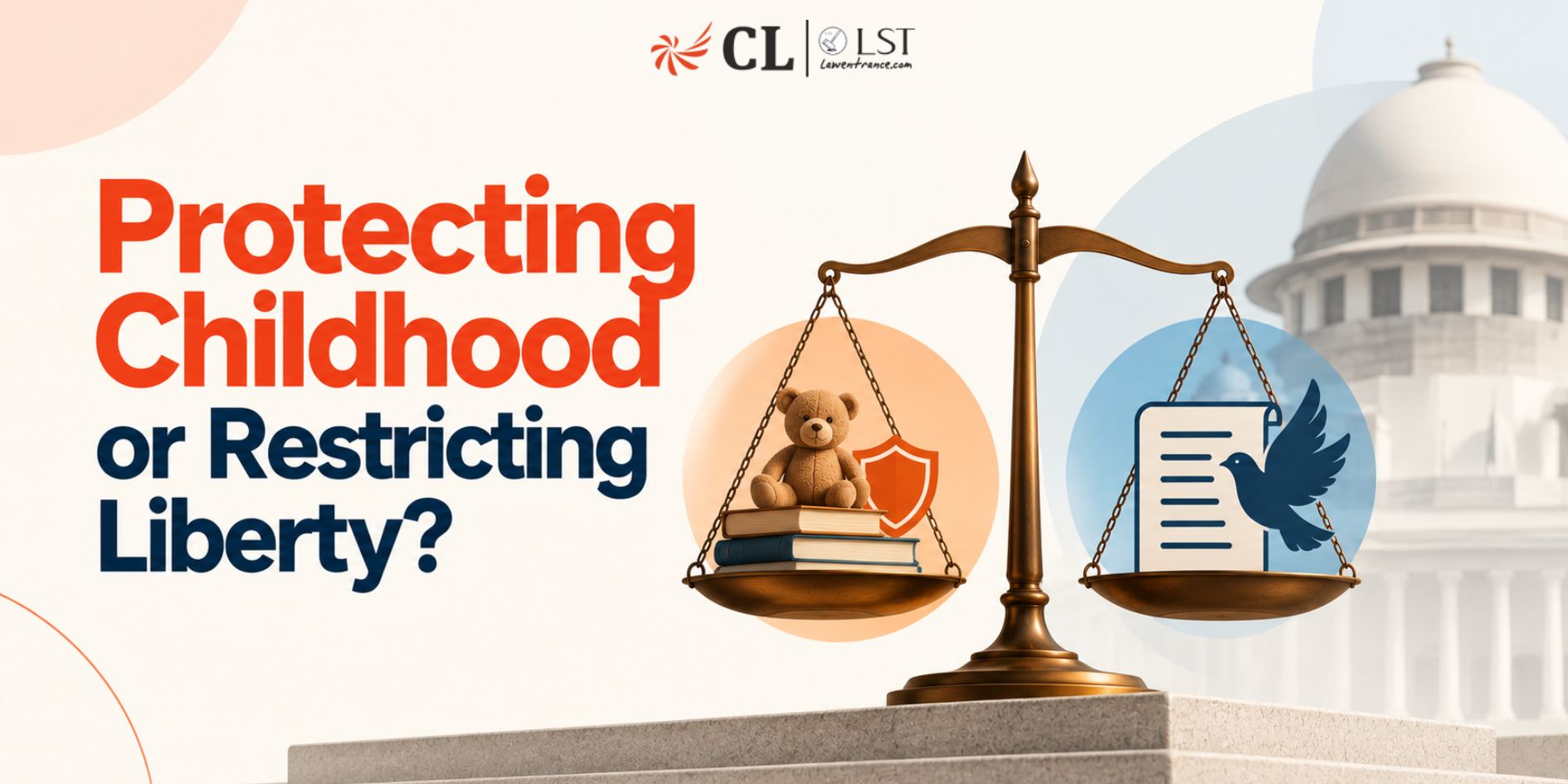
Protecting Childhood or Restricting Liberty? The Constitutional Limits of Age-Based Social Media Regulation in India
Introduction
For this generation Z it’s not about only entertainment when it comes to social media. This is a platform beyond their physical world where they create friendships, understand the news of the world, comprehend the effect of political opinions and reform their identity according to peer reviews. These social media platforms rely on this need through targeted ads, phishing and other forms of pulls which have impacted the minors of the country in a very adverse way and now have become a genuine concern among the parents. The economic survey of 2025-26 has urged the government to initiate the age restriction on the usage of social media along with strict verification process for age-based entry into platforms. This step will help to curb the auto play schemes and targeted advertisement to minors, although when look at closely all these steps are doing is promoting blanket ban on usage by minors which might have the opposite effect of what is intended (Storyboard18, 2026). Taking example from Australia who have recently initiated the minimum age requirement for all the social media platforms that will prevent any person less than the age of 16 to approach these platforms (social media Minimum Age) Act, 2024). This is where the decisive point of India comes into picture. This article tries to argue that the age-based restriction is constitutionally valid only if it stands on strong statute and graded on the basis of its capability to complement the evolving issue of child safety. A blanket under-18 prohibition imposed through delegated legislation would be vulnerable under Articles 14, 19 and 21 of the Constitution.
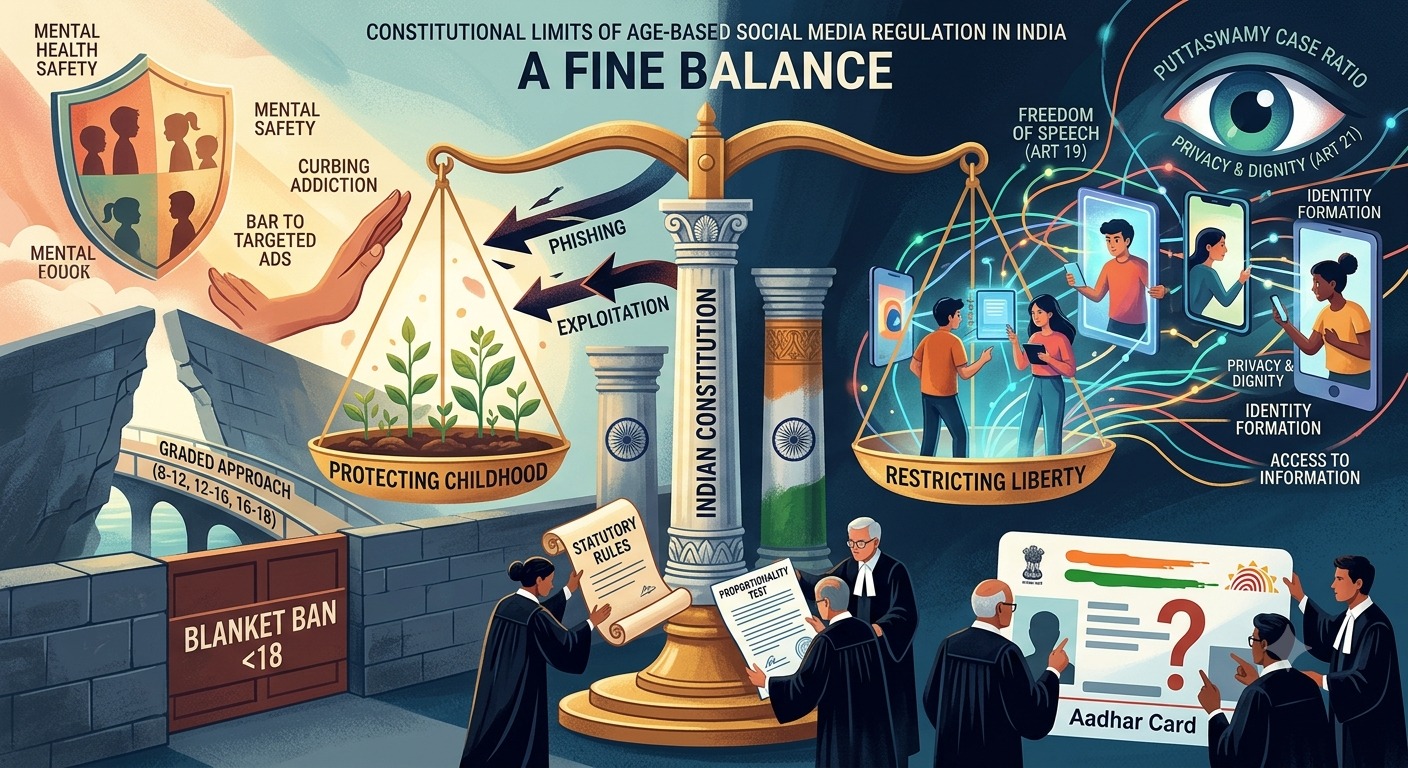
Table of Contents
Constitutional Foundations and Judicial Milestones
The analysis starts with the ratio of Justice K.S. Puttaswamy (Retd.) v. Union of India (2017), wherein the emphasize was put on the privacy to be regarded as fundamental right under Article 21. This stems from the fact that privacy is a component of dignity and autonomy and its open to any form of restriction only with solid legal backing. Further discussion, this case also reiterated that a structured test of ultimate goal, rationality, necessity and balances will be required to question any mark on right to privacy. In further case of Anuradha Bhasin v. Union of India (2020), it was held that expression of ideas and trade carried on internet will be covered under the banners of constitution freedom of Article 19 and here to any restriction will have to be satisfies through pillar of proportionality. This means that any restriction put on the minors to uses social media will have to justify a demanding standard and simply not because of concern of child welfare. Even all International laws points in the exact same direction. The UN Committee on Rights of the Child (2021) has also pressed on the fact that the right of child applies completely in usage of social media environment and their protection has to be in connotation with their evolving capacities to comprehend the media.
The Statutory Framework: Data Protection and Contract Law
Two statutes currently frame the position of minors online. First, the Digital Personal Data Protection Act, 2023 defines a child as a person below eighteen and, under Section 9, requires verifiable parental consent before a child’s data is processed. It also bars processing that harms a child’s well-being and prohibits tracking, behavioural monitoring and targeted advertising directed at children (Digital Personal Data Protection Act, 2023, § 9). The Digital Personal Data Protection Rules, 2025 operationalise this through Rule 10, which requires parental consent to be verified through age and identity checks (Mondaq, 2025). These obligations, however, are due to bind platforms only from May 2027 (Bansal, 2026).
Second, Section 11 of the Indian Contract Act, 1872 makes a minor incompetent to contract, and an agreement with a minor is void, a position settled since Mohori Bibee v. Dharmodas Ghose (1903). Because platform terms of service are contracts, it is argued that account creation by minors rests on an agreement the law does not recognise (Bansal, 2026).
Recent Developments: From Announcements to Adjudication
The past year shows a policy debate moving from announcements to adjudication. In December 2025, the Madras High Court asked the Union to consider an Australia-style law for children under 16, and in March 2026 Karnataka announced a ban for children below 16 in its State Budget (Bansal, 2026; Press Trust of India, 2026). The Internet Freedom Foundation (2026) responded that a budget announcement left unanswered questions about the legal mechanism, enforcement and the privacy risks of age verification. In August 2026, the Delhi High Court declined to order a ban, describing the matter as one of policy (Bansal, 2026).
The most significant step came on 28 September 2026. Hearing a petition by the Just Rights for Children Alliance, a bench headed by the Chief Justice of India asked the Centre to consider placing in statutory form the requirement that platforms comply with Indian laws governing minors, including their incapacity to contract (ANI, 2026). The Solicitor General reportedly told the Court that the Centre would amend the Information Technology (Intermediary Guidelines and Digital Media Ethics Code) Rules, 2021 to stop platforms from allowing under-18s to open accounts, while allowing parental consent for educational websites (Bansal, 2026). The text of the proposed amendment was not available in the sources consulted, so the proposal is assessed here in principle.
A Proportionality Assessment
Applying the Puttaswamy (2019) test, the aim of protecting children’s mental health and safety is plainly legitimate, and the State has a positive duty to safeguard minors under Article 21. The difficulty lies in the remaining stages.
On suitability, the evidence is mixed. Australia removed 4.7 million accounts within a month of its under-16 law, yet a Reuters test later found that platforms asked for proof of age on none of 50 accounts, and 438 scientists have urged a pause on age-based controls until their benefits and risks are better understood (Bansal, 2026).
When we talk about the pillar of necessity there are various alternative which exists to be utilized. Default safety setting on electronics, time limitation on Autoplay options on streaming platforms and also the existing bar which is provided by the statute itself on the tracking of the advertisement targeting and Phishing systems which are capable of addressing the harm without providing complete usage ban for the minors.(Bansal, 2026).This is why the three tier system of age groups ranging from 8-12, 12-16 and 16-18 is much closer to fulfilling the capacities and promises as indicated by the UN committee of Rights of Child( 2021).It is very important to be understood that there is a vast difference between a 16 year old using the social media for information, and exercising his freedom of speech as compared to a 9 year old and therefore requires that the restriction shall have to reflect according to the to age barrier and the effect that follows.( Bhasin, 2020)
On the Piller of Balancing, the age verification process is a burden on very single user, not just the minors. There are many authors who believe that this verification could effectively be converted to Aadhar verification which will create a reusable layer of identity which will have multiple repercussions especially when looked through the lens of Puttaswamy (2017) (Bansal, 2026). These kinds of blanket restrictions risk exclusion based on gender (Internet Freedom Foundation, 2026) and many studies have reflected that social media usage is actually the only way to interact with the outside world Bansal, 2026)
Then comes the end point which is the issue of legality. The restrictions which are imposed by the usage of Article 19(2) for freedom of speech should be imposed by law and any legislation which is delegated further will not go beyond the original act under any circumstances. Indian contract Act, 1872 explain very well that any agreement with minor is void from the beginning, but this act does not impose a positively duty form on the social media platforms to exclude the usage by minors. This issue of silent incapacity into access ban on all needs a better wording in the statute which is not getting fulfilled under the aegis of Information Technology Act, 2005 which is why there is still debate to make a closer ended and throughout individual statutes which targets the usage and prevention of illicit activities on these platforms involving minors(ANI, 2026).
Conclusion
The worry and the effort for shielding this generation from the acute harms of unsafe social media usage is at a very delicate turning point. The apex court of has discussed many times that the welfare of the minor and their protection cannot be measured through any guidelines or budget points. It is very important that a statute is formed which is constitutionally strong with proper age structure usage, safety measures, privacy and assurances of age mannered usage which will replace the unnecessary identify linked checks, and parent support options which have currently not been working well on nay platforms. Anything else other than this will rock the protection of children from such platforms and policing the generation which questions everything imposed on them without reasonable cause.
Author

Popular Posts
MH-CET Law 2025 Cutoff(5-Year)Out: Check Past Year Trends, & More
By CL LST Team
27 May 2025 12559
CLAT 2026 Question Paper (Updated) – Download CLAT 2026 Question Paper PDF
By CL LST Team
09 Dec 2025 10222

MH-CET Law 2025 Result OUT! [Direct Link to Score card]
By CL LST Team
05 Jun 2025 9247
MH CET Law Reservation Policy
By CL LST Team
31 Mar 2025 8186
Latest Posts
Protecting Childhood or Restricting Liberty? The Constitutional Limits of Age-Based Social Media Regulation in India
By CL LST Team
23 Oct 2026 14
CLAT 2027 Last 30 Days Strategy to Maximize Your Score
By CL LST Team
16 Oct 2026 82
CLAT 2027 Answer Key: Expected Release Date, PDF Download, and Objection Process
By CL LST Team
14 Oct 2026 103
SLAT Results 2027: Date, Scorecard and Merit List
By CL LST Team
13 Oct 2026 75