What is CLAT? The Complete Guide for Aspiring Law Students
What is CLAT: So you’ve heard the word “CLAT” floating around, in school, from a senior, maybe from a coaching ad. And you’re wondering: what exactly is it, and is it relevant to me?
Here’s the short answer: CLAT (Common Law Admission Test) is India’s national entrance exam for getting into the best law colleges in the country – the National Law Universities (NLUs). Think of it the way JEE is the gateway to IITs. CLAT is that same gateway, but for law.
Now let’s break it all down.
Table of Contents
What is the Full Form of CLAT?
CLAT stands for Common Law Admission Test. It’s a centralized, national-level exam conducted once a year by the Consortium of NLUs, a body of all National Law Universities in India working together.
Before CLAT existed (it started in 2008), every NLU had its own separate entrance test. Students had to appear for 5-6 different exams, often on overlapping dates. CLAT ended all that confusion with one single exam.
CLAT Exam at a Glance
| Detail | Info |
| Conducting Body | Consortium of NLUs |
| Mode | Offline (pen and paper) |
| Duration | 2 hours |
| Total Questions | 120 MCQs |
| Marking | +1 for correct, −0.25 for wrong |
| CLAT 2027 Date | 6 December 2026 (Tentative) |
| Registration | 1 August – 31 October 2026 (Tentative) |
| Fee | INR 4,000 (INR 3,500 for SC/ST/PwD/BPL) |
Who Can Give the CLAT Exam?
CLAT is conducted at two levels:
CLAT UG: For students who have just completed (or are appearing in) Class 12 and want to study law. You get into a 5-year integrated law program like BA LLB or BBA LLB.
CLAT PG: For law graduates (LLB holders) who want to pursue a Master’s in Law (LLM) from a top NLU.
Most students searching “What is CLAT” are asking about CLAT UG, so that’s what we’ll focus on.
Which Colleges Accept CLAT Scores in India?
There are 27 National Law Universities across India that accept CLAT scores, from NLSIU Bangalore (the oldest and most prestigious) to newer NLUs in states like Tripura and Goa. Beyond NLUs, over 40 other affiliated private law colleges also use CLAT scores for admission.
What Subjects Are There in the CLAT Exam?
One thing that surprises most beginners: CLAT is entirely passage-based. You won’t be asked to memorize bare acts, legal definitions, or grammar rules. Every question gives you something to read first, then asks you to think and answer.
There are 5 subjects in CLAT UG:
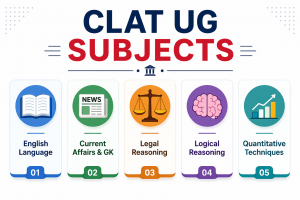
| Subject | Questions | Weightage | What It Actually Tests |
| English Language | 22-26 | 20% | Reading comprehension, inference, and vocabulary in context. No grammar rules to mug up. |
| Current Affairs & GK | 28-32 | 25% | News-based passages from India and the world. The biggest section, daily newspaper reading, is non-negotiable. |
| Legal Reasoning | 28-32 | 25% | Applying a given legal principle to a situation. You don’t need to know any law beforehand. |
| Logical Reasoning | 22-26 | 20% | Arguments, assumptions, conclusions. Pure thinking ability, no tricks. |
| Quantitative Techniques | 10-14 | 10% | Class 10-level math. Basic arithmetic and data interpretation. The smallest section, but don’t ignore it. |
Also Check: CLAT 2027 Syllabus
What is the Eligibility Criteria for CLAT?
The eligibility for CLAT UG is simple:
- You must have passed Class 12 (or be appearing this year)
- Minimum 45% marks in 12th (40% for SC/ST students)
- No age limit – anyone can appear, regardless of age
- No limit on attempts – you can try as many times as you want
Any stream works – Science, Commerce, or Arts. CLAT doesn’t care which board you studied under.
Also Check: Eligibility Criteria for CLAT
How Many Students Appear for CLAT Every Year?
Here’s something that puts things in perspective: 92,344 students applied for CLAT 2026, a 17% jump from the previous year. Out of these, 75,009 were UG applicants, and 17,335 were PG applicants.
That’s a lot of competition, but here’s the flip side: a student who cracks CLAT with a strong rank has genuinely beaten nearly a lakh aspirants to get there. That means something.
Also Read: How to prepare for CLAT?
Is CLAT Exam Tough? Honest Answer for Beginners
Compared to JEE or NEET, CLAT tests different skills – reading speed, current affairs awareness, and logical thinking, rather than formula-heavy science. But it’s no pushover either. The competition is intense, and the passage-based format trips up many students who haven’t practiced enough.
The good news: CLAT rewards consistent preparation over a long period, not last-minute cramming.
How to Prepare for CLAT Exam as a Beginner?
If you’re in Class 11 or 12 and serious about law, here’s what actually works:
- Read a newspaper daily: The Hindu or Indian Express. Current Affairs is 25% of the paper.
- Practice passages: CLAT is entirely reading-based. Speed and comprehension matter.
- Solve previous year papers: Nothing explains the exam pattern better than actual CLAT papers.
- Take mock tests regularly: Time management under pressure is a skill you build only through practice.
- Don’t ignore Legal Reasoning: It’s learnable and highly scoring once you understand how to apply principles.
Career Launcher’s CLAT test series is a good starting point if you’re not sure how to structure this – it paces mocks progressively as your prep advances.
Final Word
CLAT is the single most important exam for anyone who wants to study law at a National Law University in India. It’s fair, it’s standardized, and it rewards students who read widely and think clearly.
If law is your dream, CLAT is your starting point.
If you’re just starting out and want a guided plan instead of figuring this out alone, CL-LST’s CLAT online crash course covers all five sections with the same structure used in this guide.
Frequently Asked Questions (FAQs)
Q: Can I give CLAT after 12th?
A: Yes, that’s exactly when most students give it.
Q: Is the CLAT Exam online?
A: No, it’s an offline (pen-and-paper) exam.
Q: Does stream matter in the CLAT Exam?
A: No – Science, Commerce, and Arts students all appear together.
Q: When is CLAT 2027?
A: 6 December 2026. Registration opens 1 August 2026.
Author

Popular Posts

MH-CET Law 2025 Cutoff(5-Year)Out: Check Past Year Trends, & More
By CL LST Team
27 May 2025 12498
CLAT 2026 Question Paper (Updated) – Download CLAT 2026 Question Paper PDF
By CL LST Team
09 Dec 2025 9656
![MH-CET Law 2025 Result OUT! [Direct Link to Score card]](https://www.lawentrance.com/blogs/wp-content/uploads/2025/06/ChatGPT-Image-Jun-5-2025-04_52_35-PM.png)
MH-CET Law 2025 Result OUT! [Direct Link to Score card]
By CL LST Team
05 Jun 2025 9186
MH CET Law Reservation Policy
By CL LST Team
31 Mar 2025 8098
Latest Posts
BA LLB vs BBA LLB: Differences, Career Scope, Salary & More
By CL LST Team
08 Sep 2026 70
AILET 2027 Preparation in 90 Days: Study Plan, Strategy & Tips
By CL LST Team
05 Sep 2026 75
How to Manage CLAT 2028 Preparation in Class 11: A Practical Guide
By CL LST Team
02 Sep 2026 90
SLAT Exam Centres 2027: Complete List of Test Cities
By CL LST Team
27 Aug 2026 87