What is AILET Exam? A Simple Guide for Law Aspirants
What is AILET Exam: So you’ve been researching law entrance exams and keep seeing two names: CLAT and AILET. You already know what CLAT is. But what exactly is AILET, and should you be preparing for it too?
Here’s the short answer: AILET (All India Law Entrance Test) is the entrance exam for NLU Delhi, one of the most prestigious law universities in India. It’s separate from CLAT, conducted independently, and if NLU Delhi is on your list, AILET is non-negotiable.
Table of Contents
What is the Full Form of AILET?
AILET stands for All India Law Entrance Test. It is conducted by the National Law University, Delhi, exclusively for admissions to its own law programs. Unlike most NLUs that accept CLAT scores, NLU Delhi runs its own entrance exam, making AILET unique in the entire law entrance landscape.
AILET Exam at a Glance
| Detail | Info |
| Conducting Body | National Law University, Delhi |
| Mode | Offline (pen and paper) |
| Duration | 2 hours (120 minutes) |
| Total Questions | 150 MCQs |
| Total Marks | 150 |
| Marking | +1 correct, −0.25 wrong |
| Total UG Seats | 110-120 |
Check: AILET UG 2027 Syllabus
What is the Eligibility Criteria for AILET?
- Must have passed Class 12 or be appearing this year.
- Minimum 50% marks in 12th for General category (45% for SC/ST).
- No upper age limit.
- Any stream: Science, Commerce, or Arts.
Also Check: Eligibility for AILET Exam
What Subjects Are There in the AILET Exam?
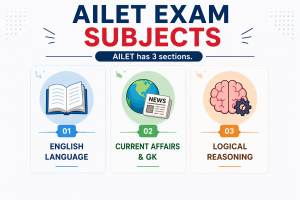
AILET has 3 sections – not 5 like CLAT, and this is where AILET and CLAT are fundamentally different.
| Subject | Questions | Weightage | What It Actually Tests |
| English Language | 50 | 33% | Comprehension, grammar, vocabulary, inference. More direct and grammar-heavy than CLAT. |
| Current Affairs & GK | 30 | 20% | Indian and global events, static GK, awards, sports, and important personalities. |
| Logical Reasoning | 70 | 47% | Assumptions, Arguments, Inferences, Puzzles, Seating Arrangements, etc. |
The big difference from CLAT: No separate Legal Reasoning section, no Quantitative Techniques. Logical Reasoning in AILET carries nearly half the paper and also covers legal principles within it.
How Many Students Appear for AILET Every Year?
Around 20,000-25,000 students appear for AILET every year, all competing for just 110 UG seats at NLU Delhi. That ratio makes AILET one of the most competitive seats in Indian legal education.
Is AILET Tougher Than CLAT?
Honestly, yes, slightly. Fewer seats, faster pace (100 questions in 90 minutes vs CLAT’s 120 in 120), and a slightly harder English section. That said, most serious CLAT aspirants prepare for AILET simultaneously without much extra effort since the syllabus is nearly identical.
AILET vs CLAT – Key Differences
| Factor | CLAT | AILET |
| Conducted by | Consortium of NLUs | NLU Delhi |
| Colleges | 26 NLUs + 40+ affiliated | Only NLU Delhi |
| UG Seats | 4,000+ | 110 |
| Duration | 2 hours | 2 hours |
| Questions | 120 | 100 |
Also Read: AILET vs CLAT
How to Prepare for the AILET Exam?
- Understand the latest AILET exam pattern and syllabus.
- Focus on English, Logical Reasoning, and Current Affairs & General Knowledge.
- Read newspapers regularly to improve reading skills and stay updated with current affairs.
- Practice mock tests to build speed, accuracy, and time management.
- Revise consistently to improve retention and performance.
Final Word
AILET is not just another law entrance exam – it’s the only gateway to NLU Delhi. If that’s your dream college, treating AILET as an afterthought to CLAT would be a mistake. The syllabus overlaps heavily, but AILET demands sharper speed and slightly different strategy.
Prepare for both. NLU Delhi is worth the extra effort.
Frequently Asked Questions (FAQs)
Q: Can I get into NLU Delhi through CLAT?
A: No. NLU Delhi only accepts AILET scores.
Q: Can I prepare for CLAT and AILET together?
A: Yes – the syllabus is nearly identical. Most students prepare for both simultaneously.
Q: Is AILET online or offline?
A: Offline – pen and paper-based.
Q: When is AILET conducted?
A: The same month as CLAT. Both exams typically fall within days of each other.
Author

Popular Posts

MH-CET Law 2025 Cutoff(5-Year)Out: Check Past Year Trends, & More
By CL LST Team
27 May 2025 12498
CLAT 2026 Question Paper (Updated) – Download CLAT 2026 Question Paper PDF
By CL LST Team
09 Dec 2025 9656
![MH-CET Law 2025 Result OUT! [Direct Link to Score card]](https://www.lawentrance.com/blogs/wp-content/uploads/2025/06/ChatGPT-Image-Jun-5-2025-04_52_35-PM.png)
MH-CET Law 2025 Result OUT! [Direct Link to Score card]
By CL LST Team
05 Jun 2025 9186
MH CET Law Reservation Policy
By CL LST Team
31 Mar 2025 8098
Latest Posts

BA LLB vs BBA LLB: Differences, Career Scope, Salary & More
By CL LST Team
08 Sep 2026 70

AILET 2027 Preparation in 90 Days: Study Plan, Strategy & Tips
By CL LST Team
05 Sep 2026 75

How to Manage CLAT 2028 Preparation in Class 11: A Practical Guide
By CL LST Team
02 Sep 2026 90

SLAT Exam Centres 2027: Complete List of Test Cities
By CL LST Team
27 Aug 2026 87