CLAT 2028 Reforms: Proposed Changes Explained

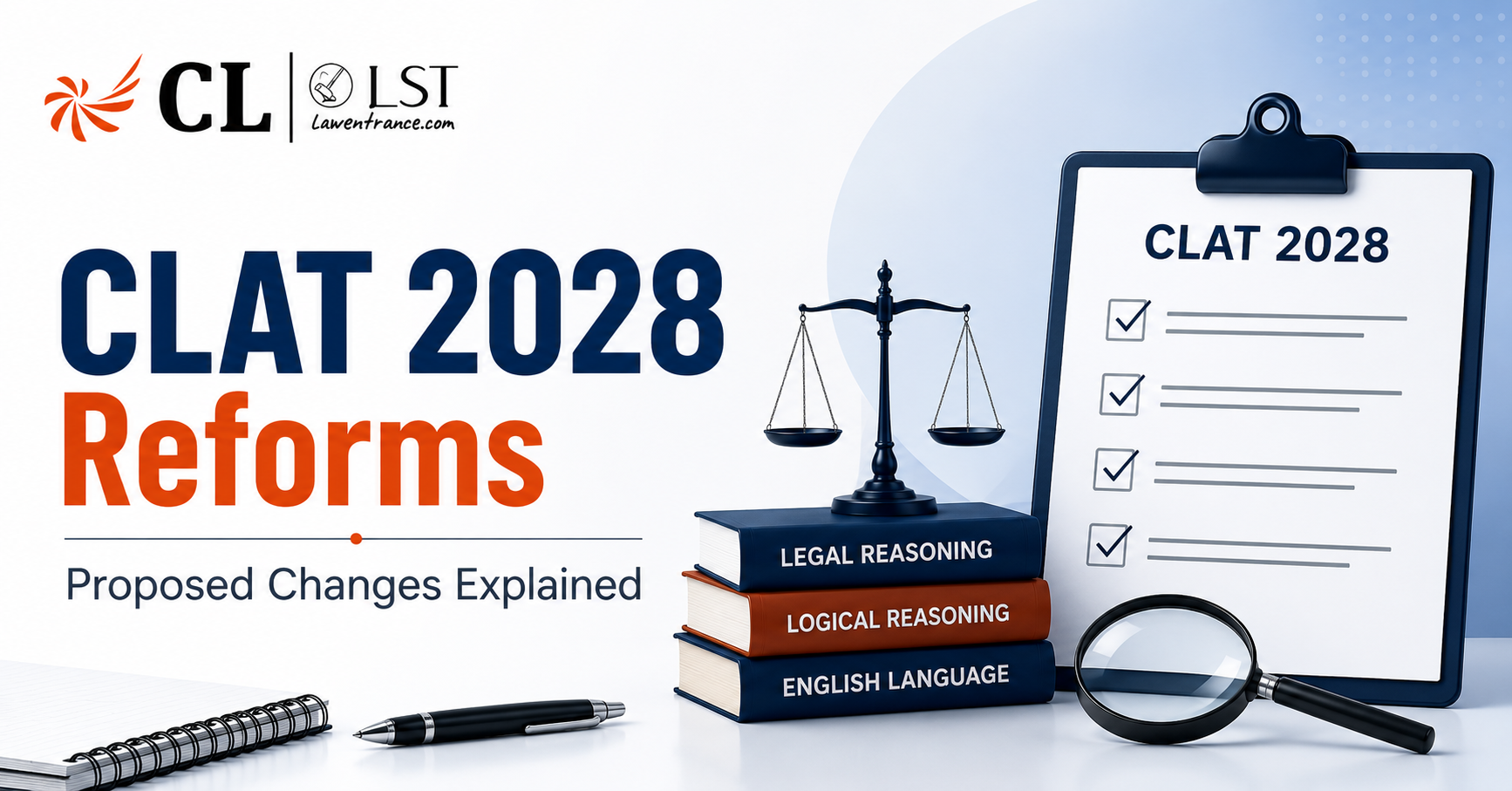
The Consortium of National Law Universities has proposed a set of major reforms to the CLAT exam, and if you are in Class 11 preparing for CLAT 2028, this news directly affects how you should plan your preparation. Here is what the Consortium’s official press release actually says, and what it means for your preparation strategy.
What Are the CLAT 2028 Reforms About?
In September 2025, the Consortium set up an Expert Committee to review how CLAT tests students. The committee included law professors from Oxford, LSE, Columbia, Cambridge, and BML Munjal University, and it submitted its final report on February 2, 2026.
The Consortium’s Governing Body met on July 18, 2026, and passed three resolutions:
- CLAT 2027 will not change. The syllabus and pattern for both UG and PG papers stay the same. Paper setters may only use the committee’s suggestions to improve question quality, not to change the structure.
- The report is now public, and feedback from students, teachers, and the wider public is open until August 31, 2026.
- CLAT 2028 decisions rest with a separate committee, which the Office of the Chief Justice of India will set up. This committee will review the report along with public feedback before anything is finalized.
CLAT 2028 changes, in other words, are proposed and not approved. Nothing is locked in yet.
What could the CLAT 2028 New Pattern look like?
The Expert Committee’s report suggests moving CLAT UG from five sections to three:
- Merge Legal Reasoning and Logical Reasoning into one section
- Rename the English section to Language and Comprehension
- Remove General Knowledge and Current Affairs as a separate section
- Keep Quantitative Techniques, with more focus on aptitude and numerical reasoning
The current UG paper is two hours long. The proposed changes focus on the structure and content of the paper rather than its duration. The committee also recommended a more professional paper-setting process, since the current system rotates the job between NLUs each year, and that rotation has led to errors in past papers.
None of this applies to CLAT 2027. If it is approved, it would only take effect from CLAT 2028 onward.
Will GK and Current Affairs Be Removed in the CLAT 2028 New Pattern?
This is the question most Class 11 students are asking, and the honest answer is that it might be, but it has not been decided.
The committee reasons that CLAT should test reasoning and comprehension skills rather than memory of current events. But that is still a recommendation. The CJI-appointed committee has to review it, along with public feedback, before it becomes official. Until that happens, GK and Current Affairs stay part of CLAT.
Drop this section now on the assumption that it will disappear, and if the reform gets delayed or rejected, you have lost a year of preparation on a section worth 25% weightage in the current pattern.
CLAT 2027 vs Proposed CLAT 2028: What Could Change?
| Area | CLAT 2027 (Confirmed) | CLAT 2028 (Proposed, Not Final) |
| Number of sections | 5 | 3 |
| GK & Current Affairs | Separate section | May be removed |
| Legal Reasoning | Separate section | May merge with Logical Reasoning |
| English | English Language | May be renamed Language and Comprehension |
| Quant Techniques | Present | Present, more aptitude-focused |
| Exam duration | 2 hours | Expected to stay 2 hours |
This uncertainty is exactly why Class 11 students should avoid making major changes to their preparation based on proposed reforms. Build a strong foundation in reading, reasoning, and quantitative skills, while keeping your preparation flexible until the CLAT 2028 exam pattern is officially confirmed.
Also Read: Is it too early for CLAT 2028 Prep?
What Do the CLAT 2028 Reforms Mean for Class 11 Students?
You are preparing for an exam that might change, so the strategy has to work either way.
- Do not skip GK and Current Affairs. It is still part of the exam, and reading habits built now take months to develop. Stopping and restarting later costs more time than just continuing.
- Build strong reasoning skills instead of section-specific tricks. Whether Legal and Logical Reasoning stay separate or merge, the underlying skill, reading a situation and applying logic to it, does not change.
- Focus on comprehension in English, whatever the section ends up being called. Reading speed and accuracy matter under any pattern.
- Stay updated with official announcements: Follow the Consortium of NLUs and the CJI-appointed committee for confirmed updates, and verify any major change before altering your preparation strategy.
- Choose a prep structure that can adapt: A rigid, single-pattern study plan is risky right now. A structured online CLAT coaching programme can help you build a strong foundation across the current sections while developing skills that remain useful under either pattern.
Conclusion
The proposed CLAT 2028 reforms could change how the exam is structured, but the final pattern is not confirmed yet. For Class 11 students, the best approach is to avoid making major preparation changes based on proposals alone.
For now, focus on building strong reading, comprehension, reasoning, and quantitative skills while continuing your current preparation. Keep track of official updates and be ready to adapt once the CLAT 2028 pattern is formally announced. A strong foundation will remain valuable, regardless of how the final paper is structured.
Free Resources: CLAT Free Mock Test | CLAT Previous Year Papers
Frequently Asked Questions
Is the CLAT 2028 new pattern confirmed?
No. It is a proposal from the Expert Committee report. A separate committee, set up by the Office of the Chief Justice of India, will review it before any decision is made.
When will CLAT 2028 changes be finalized?
There is no confirmed date yet. Public feedback closes on August 31, 2026, after which the CJI-appointed committee will review the report and feedback together.
Should Class 11 students stop studying GK and Current Affairs?
No. The section is still part of CLAT as it stands. Removing it is only a proposal, not a decision.
Where can I check official CLAT 2028 updates?
Always confirm through the Consortium of NLUs’ official website or verified sources.
Author

Popular Posts

MH-CET Law 2025 Cutoff(5-Year)Out: Check Past Year Trends, & More
By CL LST Team
27 May 2025 12543
CLAT 2026 Question Paper (Updated) – Download CLAT 2026 Question Paper PDF
By CL LST Team
09 Dec 2025 10032
![MH-CET Law 2025 Result OUT! [Direct Link to Score card]](https://www.lawentrance.com/blogs/wp-content/uploads/2025/06/ChatGPT-Image-Jun-5-2025-04_52_35-PM.png)
MH-CET Law 2025 Result OUT! [Direct Link to Score card]
By CL LST Team
05 Jun 2025 9230
MH CET Law Reservation Policy
By CL LST Team
31 Mar 2025 8163
Latest Posts
SLAT Results 2027: Date, Scorecard and Merit List
By CL LST Team
13 Oct 2026 0
CLAT 2028 Syllabus: Section-wise Topics and Proposed Changes
By CL LST Team
08 Oct 2026 67
AILET 2027 Marks vs Rank: Expected Rank for Your Score
By CL LST Team
06 Oct 2026 80
Most Common Mistakes to Avoid in CLAT 2027
By CL LST Team
05 Oct 2026 49