Is it too early for CLAT 2028?

Is it too early for CLAT 2028? So you are thinking about appearing for CLAT exam. Maybe you just heard about it from a senior, or maybe you have been researching law entrance exams for a while now. Either way, one question is probably on your mind right now: Is it too early to start preparing for CLAT 2028?
The answer is a clear No.
CLAT 2028 is scheduled to be conducted on 5th December 2027 (tentatively) as per previous years’ trends, which means you have approximately 15 months from today. That is not too early; that is exactly the right time to begin. In this blog, we break down why starting now gives you a decisive edge and exactly what you should be doing in these early months.
Why Starting CLAT 2028 Preparation Right Now Makes Sense
Most aspirants make the mistake of waiting until Class 12 begins, or worse, until six months before the exam, to start preparing. By then, the window for building strong fundamentals has already closed.
Here is why starting your CLAT 2028 preparation today is the smartest decision you can make:
- CLAT 2028 takes place in December 2027, giving you roughly 21 months of focused preparation time.
- Starting early allows you to give each section the time it needs without rushing or compromising on any subject.
- You can focus on strengthening your basics across English, GK, Legal Reasoning, Logical Reasoning, and Quantitative Techniques, without the pressure of an imminent exam.
- Early preparation also means you can use CLAT 2027 as a trial attempt, giving you real exam experience before CLAT 2028, your main attempt.
- Aspirants who start early consistently outperform last-minute preppers in comprehension speed, retention, and accuracy.
Check CL-LST CLAT Preparation Programs – CLAT 2028 Online Coaching
Early Starter vs Late Starter: What the Difference Looks Like
Still wondering whether it really matters when you start? Here is a straightforward comparison:
| Factor | Early Starter | Late Starter |
| Time for Basics | Deep, Unhurried Coverage | Rushed, often skipped |
| GK Preparation | Systematic, well-retained | Cramming, low retention |
| Reading Habit | Built naturally over months | Forced, inconsistent |
| Trial Attempt | CLAT 2027 as a trial | First attempt = Only attempt |
| Exam Day Confidence | High – well-prepared, well-retained | Low – stressed, uncertain |
What Should You Do Right Now? A Section-wise Action Plan
Now that you know why starting early helps, focus on building strong study habits and basics in the initial months. Avoid rushing into mock tests or heavy memorization at this stage.
1. Focus on the Basics of Each Section
This is the most important step for any aspirant beginning their CLAT preparation journey early. Before you attempt any CLAT-level questions, make sure you understand the fundamental concepts of each section.
- English Language: Understand how comprehension passages are structured. Practice identifying the main idea, tone, and inference of a passage.
- Legal Reasoning: Build familiarity with legal principles and their application to factual situations. You do not need to memorise laws at this stage.
- Logical Reasoning: Strengthen your ability to identify logical connections, assumptions, and conclusions.
- Quantitative Techniques: Revisit Class 10-level arithmetic. CLAT QT is not complex, but accuracy and speed matter.
- Current Affairs & GK: Begin tracking national and international news. Understand the context behind major events, not just the headlines.
2. Strengthen Your Static GK Foundation
Static GK is one area where early preparation pays the highest dividends. Unlike current affairs, static GK does not change; every fact you learn today stays with you.
- Cover NCERT Polity (Class 9-12) systematically. Constitutional provisions and landmark judgements are high-yield areas for CLAT.
- Build a list of important Supreme Court judgments and their significance.
- Study basic legal terminology, you will encounter it repeatedly in the Legal Reasoning section.
- Cover Indian History, Geography, and Economy at the NCERT level.
Also Read – CLAT 2028 Preparation Guide
3. Develop the Newspaper Reading Habit
If there is one habit that CLAT toppers swear by, it is reading a quality newspaper every single day. For CLAT 2028 aspirants, this habit is non-negotiable.
- Read The Hindu or Indian Express for 30 minutes daily; focus on the editorial and national/international news sections.
- This habit directly improves your comprehension speed, vocabulary, and current affairs knowledge simultaneously.
- Make short notes of important events, judgments, and policy developments as you read.
4. Build Your 2-Hour Concentration Block
CLAT is a 2-hour exam. Yet most aspirants have never actually sat focused and undistracted for 120 minutes until they are inside the exam hall, and that is a serious problem.
- Start by sitting for focused, distraction-free study for 45 minutes daily. Gradually extend this to 2 hours over the next few weeks.
- No phone, no notifications, no background noise during this block. Train your brain to sustain concentration.
- By the time CLAT 2028 arrives, 2 hours of focused effort should feel completely normal to you.
5. Build Comfort with Diverse Reading Themes
CLAT comprehension passages can come from virtually any domain, science and technology, environmental policy, economics, or even fictional literature. Aspirants who read only legal content are often caught off guard.
- Read across diverse topics: science, technology, international relations, philosophy, fiction, and current policy issues.
- Expose yourself to different writing styles and vocabulary. The more varied your reading, the faster you will process unfamiliar passages on exam day.
- Set aside 15-20 minutes daily specifically for non-legal, non-current-affairs reading.
Use CLAT 2027 as Your Trial Attempt for CLAT 2028
One of the most powerful and underused strategies available to CLAT 2028 aspirants is treating CLAT 2027 as a serious trial run. Here is why every serious aspirant should consider this:
- You experience the actual exam environment, the exam hall, the time pressure, the question flow, without your target attempt riding on it.
- You discover your real weak areas, not the ones you assumed were weak during self-study.
- You walk into CLAT 2028 having already sat for the exam once before. The anxiety and uncertainty are gone.
- Even if you clear CLAT 2027 and secure admission at a good NLU, a strong CLAT 2028 performance can still secure you a Top 5 NLU seat.
Frequently Asked Questions (FAQs)
Q: Is it really too early to start CLAT 2028 preparation right now?
A: No. Starting now gives you about 21 months to build strong fundamentals, develop reading habits, and even use CLAT 2027 as a trial attempt.
Q: I am currently in Class 11. How do I balance my board preparation and CLAT 2028 preparation?
A: Class 11 is an ideal time to start. Focus on newspaper reading, GK, and improving reading speed while managing school studies.
Q: Should I appear for CLAT 2027 as part of my CLAT 2028 strategy?
A: Yes. Appearing for CLAT 2027 as a trial attempt gives real exam experience and helps identify weak areas early.
Q: How many hours should I study for CLAT 2028 at this early stage?
A: Around 1.5-2 hours of focused study daily, along with 30 minutes of newspaper reading, is enough at the beginning.
Q: Which section should I prioritize first when starting CLAT 2028 preparation?
A: Start with newspaper reading and static GK, as they take the longest to build and support other sections like English and Current Affairs.

Author

Popular Posts

MH-CET Law 2025 Cutoff(5-Year)Out: Check Past Year Trends, & More
By CL LST Team
27 May 2025 12498
CLAT 2026 Question Paper (Updated) – Download CLAT 2026 Question Paper PDF
By CL LST Team
09 Dec 2025 9656
![MH-CET Law 2025 Result OUT! [Direct Link to Score card]](https://www.lawentrance.com/blogs/wp-content/uploads/2025/06/ChatGPT-Image-Jun-5-2025-04_52_35-PM.png)
MH-CET Law 2025 Result OUT! [Direct Link to Score card]
By CL LST Team
05 Jun 2025 9186
MH CET Law Reservation Policy
By CL LST Team
31 Mar 2025 8098
Latest Posts

BA LLB vs BBA LLB: Differences, Career Scope, Salary & More
By CL LST Team
08 Sep 2026 70

AILET 2027 Preparation in 90 Days: Study Plan, Strategy & Tips
By CL LST Team
05 Sep 2026 75
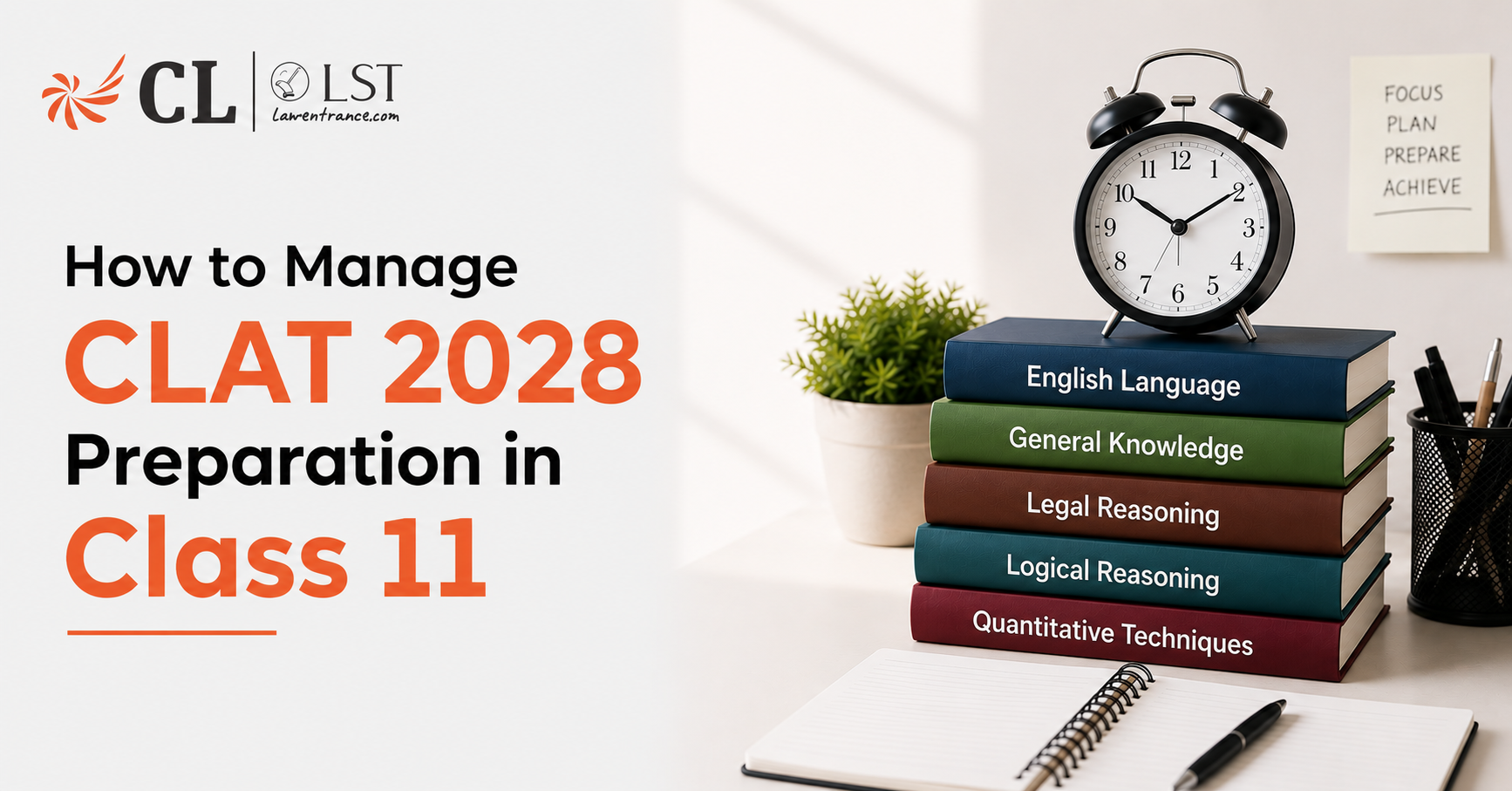
How to Manage CLAT 2028 Preparation in Class 11: A Practical Guide
By CL LST Team
02 Sep 2026 90

SLAT Exam Centres 2027: Complete List of Test Cities
By CL LST Team
27 Aug 2026 87