What is CLAT Exam?
CLAT (Common Law Admission Test) is a national-level law entrance exam conducted by the Consortium of National Law Universities (NLUs) for admission to undergraduate law programmes at 27 NLUs across India. It evaluates a candidate's reading comprehension, reasoning, and applied legal aptitude through passage-based questions rather than testing prior legal knowledge.
CLAT scores are accepted uniformly across all participating NLUs, so a single exam attempt provides admission to the entire NLU network rather than requiring separate university-level entrance tests.
CLAT 2027 Exam Dates
The Consortium has declared the CLAT 2027 exam date as Sunday, 6 December 2026, from 2:00 PM to 4:00 PM. The application form opened on 3 August 2026, and the last date to apply is 31 October 2026.
|
Event |
Date |
|
CLAT 2027 Notification Release |
July 22, 2026 |
|
CLAT 2027 Registration Start Date |
August 3, 2026 |
|
Last Date to Apply for CLAT 2027 |
October 31, 2026 |
|
CLAT 2027 Admit Card |
Third week of November 2026 (tentative) |
|
CLAT 2027 Exam Date |
December 6, 2026 |
|
CLAT 2027 Provisional Answer Key |
Within 3 to 5 days of the exam (tentative) |
|
CLAT 2027 Objection Window |
About 2 days after the provisional key (tentative) |
|
CLAT 2027 Results |
Mid-December 2026 (tentative) |
|
CLAT 2027 Counselling |
After the results |
Note: The Consortium of NLUs has officially confirmed the registration window and exam date. Admit card and result dates are tentative and based on previous years' trends.
Your Complete CLAT Guide - All in One PDF
Everything: exam pattern, NLU cutoffs, eligibility, counselling process - in one clean, free PDF.
Get the Free PDFCLAT 2027 Exam Overview
|
Test Highlights |
Details |
|
Full Form |
CLAT (Common Law Admission Test) |
|
Test Conducting Body |
The Consortium of National Law Universities |
|
Test Level |
UG |
|
Test Frequency |
Once a year |
|
Test Mode |
Offline (pen-and-paper) |
|
Test Duration |
120 Minutes |
|
Test Language |
English |
|
Marking Scheme |
+1 for correct, -0.25 for incorrect |
Attempt a Free CLAT Mock Test
Evaluate your CLAT preparation with a full-length free mock test. Get detailed performance analysis.
Take Free CLAT Mock TestCLAT Important Updates by Expert Committee
The Consortium of NLUs set up an Expert Committee, chaired by Justice Indu Malhotra, to recommend reforms to the CLAT exam. The Committee's report has since been published, with public feedback invited via the Consortium's website.
- No changes for CLAT 2027: The syllabus and pattern for both UG and PG papers remain unchanged this cycle.
- Reforms, if adopted, apply from CLAT 2028 onward: Any changes to structure, syllabus, or question format resulting from the Committee's recommendations will not affect the CLAT 2027 exam.
- The CLAT 2027 paper setters will consider the report's suggestions on question format and quality wherever feasible, without changing the sections or the syllabus.
Read the full update on our CLAT Notification page.
Other Consortium notices for CLAT 2027
The Consortium has also published the following notices on its CLAT 2027 page:
- A Persons with Disability (PwD) policy for the conduct of CLAT 2027.
- A change in the reservation category at WBNUJS Kolkata and at NLU Meghalaya.
- The removal of Vellore and Tiruvarur from the list of CLAT 2027 test cities.
Candidates should check these notices on the Consortium's CLAT 2027 page before filling in the form, since they affect category and test city choices.
CLAT 2027 Eligibility Criteria
The CLAT 2027 notification released by the Consortium confirms the following CLAT eligibility criteria to appear for the CLAT UG exam.
Educational Qualification
Any applicant who has passed the 10+2 or an equivalent examination can apply for the CLAT 2027 exam. The minimum marks required for different categories are listed below:
|
Category |
Minimum Marks in 10+2 |
|
General / OBC |
45% |
|
SC / ST / PwD |
40% |
Note: Candidates who will pass the Class 12th examination in March/ April 2027 are also eligible for the test.
Upon admission, these candidates must provide proof that they passed their Class 12th exam. Candidates who fail to fulfill this will be rejected and lose their right to admission.
CLAT 2027 Age Limit
There is no upper age limit for CLAT UG 2027. Candidates of any age who meet the educational qualification criteria can apply.
Who Can Appear for CLAT?
CLAT is an ideal choice for:
- Class 11 and 12 students planning a career in law.
- Students aiming for admission to National Law Universities (NLUs).
- Candidates interested in integrated law programs such as BA LLB, BBA LLB, BCom LLB, BSc LLB, and BSW LLB.
- Aspirants preparing for legal careers, judiciary exams, litigation, corporate law, policy, and public service.
CLAT Registration Process 2027
CLAT 2027 registration started on 3rd August 2026 and closes on 31st October 2026. Applications must be submitted online through the official Consortium website.
How to Fill the CLAT 2027 Application Form
Step 1: Register on the official CLAT website
Create an account using your mobile number and email ID.
Step 2: Verify your details
Complete OTP verification and log in to your account.
Step 3: Enter personal and academic details
Provide your name, date of birth, communication details, and qualifying examination information carefully.
Step 4: Select programme and category
Choose the appropriate UG programme and category while completing the form.
Step 5: Select examination centres
Enter your preferred test cities as required in the application form.
Step 6: Upload documents
Upload the required photograph, signature, and applicable category/PwD/BPL certificates in the prescribed format.
Step 7: Pay the application fee
Pay the applicable fee online and check the payment status.
Step 8: Submit and save the application
Review the complete form before final submission and download the confirmation page and fee receipt for future reference.
Documents Required for CLAT 2027 Registration
- Recent passport-size photograph
- Candidate's signature
- Category certificate, if applicable
- PwD certificate, if applicable
- BPL certificate, if applicable
Candidates should enter their details exactly as they appear on their official documents.
CLAT 2027 Application Fees
|
Category |
Application Fee |
|
General/OBC |
INR 4,000 |
|
SC/ST/BPL/PwD |
INR 3,500 |
|
Previous Year Question Papers |
INR 500 (Additional) |
The application fee is non-refundable and non-adjustable. Candidates opting to purchase previous years' question papers will have to pay an additional Rs. 500. Bank transaction charges, if applicable, are payable separately.
CLAT 2027 Application Correction Window
The Consortium provides a correction window for candidates to review and update specific details submitted in the application form. Candidates can log in to their account and make the permitted changes within the specified correction period. No requests for modification are generally entertained after the correction window closes.
CLAT 2027 Exam Pattern
The CLAT 2027 UG paper consists of 120 multiple-choice questions to be attempted in 2 hours. The paper is divided into five sections, with questions presented primarily through passages or sets of information.
|
CLAT 2027 Section |
Questions |
Approx. Weightage |
|
English Language |
22-26 |
20% |
|
Current Affairs including General Knowledge |
28-32 |
25% |
|
Legal Reasoning |
28-32 |
25% |
|
Logical Reasoning |
22-26 |
20% |
|
Quantitative Techniques |
10-14 |
10% |
|
Total |
120 |
100% |
Note: These weightages reflect the CLAT 2027 pattern, which remains unchanged. Any reforms recommended by the Expert Committee would apply from CLAT 2028 onward.
CLAT 2027 Marking Scheme
|
Parameter |
Details |
|
Exam Mode |
Offline (Pen and Paper) |
|
Duration |
2 Hours |
|
Total Questions |
120 MCQs |
|
Total Marks |
120 |
|
Marking Scheme |
+1 for every correct answer; -0.25 for every incorrect answer |
For a detailed section-wise breakdown, question types and preparation approach, read our complete CLAT 2027 Exam Pattern page.
CLAT 2027 Syllabus: Section-wise Important Topics
There will be no changes in the CLAT 2027 syllabus, and it will be similar to the previous year's CLAT exam.
The exam will be conducted in offline mode, where the paper has 120 questions from five different sections.
|
CLAT Subject/Section |
Brief Summary |
|
English Language |
Total Questions: 22-26 Word Count of Each Passage: 450 words each |
|
Quantitative Techniques |
Total Questions: 10-14 Word Count of Each Passage: 450 words each Expected Time to Read Each Passage: 5-7 mins |
|
Logical Reasoning |
Total Questions: 22-26 Word Count of Each Passage: 450 words each |
|
Current Affairs, including General Knowledge |
Total Questions: 28-32 Word Count of Each Passage: 450 words each Passage Source: News, journalistic sources, and other non-fiction writing |
|
Legal Reasoning |
Total Questions: 28-32 Word Count of Each Passage: 450 words each |
How to Prepare for CLAT 2027
A good CLAT preparation strategy should focus on building strong reading and reasoning skills, staying updated with current affairs and practising regularly. Follow these key steps to make your preparation more effective:
1. Understand the CLAT Syllabus and Exam Pattern
Start by understanding the five sections, question distribution, marking scheme and time limit. This will help you plan your preparation and allocate enough time to each section.
2. Build a Daily Reading Habit
Read newspapers, editorials, and reliable news sources regularly to improve reading speed, comprehension, and vocabulary. Pay attention to the main ideas, arguments, and viewpoints presented in the passages.
3. Stay Consistent with Current Affairs
Follow important national and international events throughout the year instead of leaving GK preparation for the last few weeks. Revise current affairs regularly to retain important information.
4. Practise Section-wise and Topic-wise Questions
Solve questions regularly for each section to strengthen your concepts and identify areas that need more practice. Gradually move from topic-wise practice to full-length papers.
5. Solve Previous Year Papers and Take Mock Tests
Practise CLAT previous year papers to understand the actual question style and difficulty level. Take regular mock tests to improve speed, accuracy, and time management.
6. Analyse Your Performance and Revise
Do not stop at checking your mock score. Analyse your mistakes, identify the topics where you lose marks or time, and revise them regularly. Consistent analysis and revision can make a significant difference to your performance.
CLAT 2027 Last 60 Days Preparation Plan
With the exam on 6 December 2026, the remaining weeks can be planned around the Consortium's own dates. The plan below fits the period from the start of October to the exam day.
|
Period |
Focus |
|
1 to 14 October |
Submit the application form well before the 31 October deadline. Revise all five sections once, practise one section every day, and attempt one full-length mock a week, analysed on the same day. |
|
15 to 31 October |
Move to two full-length mocks a week. Keep a short current affairs note file and revise it every third day. Solve Legal Reasoning and Logical Reasoning passages daily. |
|
1 to 14 November |
Attempt two to three mocks a week in the exam slot of 2:00 PM to 4:00 PM. Revise the topics that the mock analysis shows as weak. Check the application correction window if the Consortium opens one. |
|
15 to 21 November |
Revise the current affairs of the past year and the Quantitative Techniques formulas. Keep checking the Consortium website for the admit card. |
|
22 November to 5 December |
Download the admit card on release and check the centre. Attempt a mock every second day. Use the last three days only for light revision, with no new topics. |
|
6 December |
Report to the centre at the time printed on the admit card. |
CLAT 2027 Mock Tests
Mock tests help you understand your current preparation level and improve speed, accuracy and time management. Instead of simply checking your score, analyse every mock to identify the questions you got wrong, the questions that consumed too much time, and the sections where your accuracy needs improvement.
As the exam approaches, gradually increase the frequency of full-length mocks and practise attempting the paper within the two-hour time limit.
Attempt a Free CLAT Mock Test Explore the CLAT Test SeriesCLAT 2027 Admit Card
The CLAT 2027 admit card will be released approximately 15 days before the exam, expected in November 2026, on the official Consortium website. Carrying the admit card to the exam centre is mandatory.
Steps to Download CLAT 2027 Admit Card
- Go to consortiumofnlus.ac.in.
- Select CLAT 2027 and log in with your registered mobile number and password.
- Click the “Download Admit Card” link.
- Save the PDF and print 2-3 copies on A4 paper.
The admit card contains: Roll number, exam centre name and address, exam timing, and instructions for the day.
CLAT 2027 Exam Centres
The application form asks candidates to select their preferred test cities, and the Consortium discloses the allotted centre only on the admit card. The Consortium has removed Vellore and Tiruvarur from the list of CLAT 2027 test cities. While filling out the application form, candidates can select 3 centre preferences. The final centre list will be released by the Consortium in the official notification. Given below is the state-wise list of CLAT 2027 exam centres.
|
Andhra Pradesh |
Arunachal Pradesh |
Assam |
|
Bihar |
Chandigarh |
Chhattisgarh |
|
Delhi |
Dadra and Nagar Haveli and Daman and Diu |
Goa |
|
Gujarat |
Haryana |
Himachal Pradesh |
|
Jammu and Kashmir |
Jharkhand |
Karnataka |
|
Kerala |
Lakshadweep |
Madhya Pradesh |
|
Maharashtra |
Manipur |
Meghalaya |
|
Mizoram |
Nagaland |
Odisha |
|
Pondicherry |
Punjab |
Rajasthan |
|
Sikkim |
Tamil Nadu |
Telangana |
|
Tripura |
Uttar Pradesh |
Uttarakhand |
|
West Bengal |
- |
- |
For the city-wise list of CLAT exam centres, check our detailed CLAT 2027 Exam Centres page.
CLAT 2027 Answer Key
The Consortium releases the CLAT answer key in two stages. The provisional key comes first, along with the question booklets. Candidates get a short window to challenge it. The final key follows once the objections are reviewed, and the CLAT result is prepared from it.
|
Stage |
What to expect |
|
Provisional answer key |
Expected within 3 to 5 days of the 6 December 2026 exam (tentative) |
|
Objection window |
Short and open only through your CLAT account login. The fee is charged per objection |
|
Final answer key |
Released after objections are reviewed and before the result |
|
CLAT 2027 result |
Based on the final answer key |
Each question booklet series (A, B, C and D) has its own key, so use the one for the series printed on your booklet. Marks are calculated as +1 for each correct answer and -0.25 for each wrong one, with no deduction for unattempted questions. Compare the key with your downloaded response sheet to estimate your score for the 120-mark paper.
CLAT 2027 Results
The Consortium of National Law Universities (NLUs) releases the CLAT results right after the release of the final CLAT answer key.
The CLAT results are released in PDF format. The scorecard includes the total marks received in the exam, the overall rank attained in CLAT, the category, and other information. Candidates will be invited to the counselling procedure based on their scores. Counselling is the final stage of admission to National Law Universities (NLUs).
The result of CLAT 2027 is expected in mid-December 2026, within about ten days of the exam, as in the CLAT 2026 cycle. The scorecard is available in the candidate login and shows sectional marks, the total score, the All India Rank, and the Consortium publishes separate merit lists for UG and PG.
If two or more UG candidates have the same score, the tie is broken in this order: higher marks in the Legal Aptitude (Legal Reasoning) section, higher age, and then a computerised draw of lots.
CLAT 2027 Cutoff
The CLAT cutoff is not a fixed mark. It is the closing All India Rank for each NLU in each counselling round, and it changes every year with the number of seats, the number of candidates, and the difficulty of the paper. NLSIU Bengaluru, NALSAR Hyderabad and WBNUJS Kolkata have been the most competitive NLUs in recent cycles.
The Consortium publishes the closing ranks only through its allotment lists after each counselling round, so no CLAT 2027 cutoff exists yet. The earlier ranks, along with the paper trends, are covered in the CLAT cutoff page.
CLAT 2027 Counselling & Seat Allotment
CLAT 2027 counselling will be conducted by the Consortium after the declaration of the CLAT result. Candidates shortlisted for counselling will need to register and participate in the seat-allocation process based on their CLAT rank, category, NLU preferences, and availability of seats.
CLAT 2027 Counselling Process
- Register for CLAT counselling and pay the required counselling fee.
- Enter and confirm your preferred NLUs and programmes.
- Check the merit list and provisional seat allotment.
- Accept the allotted seat or choose an available upgrade option, as applicable.
- Complete the required fee payment and document verification within the specified deadline.
- Complete the admission formalities at the allotted NLU.
Candidates should regularly check the official Consortium website for the counselling schedule, seat-allocation rules, deadlines, and instructions.
CLAT 2027 Reservation Policy
Reservation in CLAT admissions is governed by the individual policies of participating National Law Universities (NLUs). Categories such as SC, ST, OBC, EWS, PwD, and domicile-based reservations may vary across institutions. Candidates are advised to check the reservation matrix published by the respective NLU before participating in the counselling process.
CLAT 2027 Help Desk
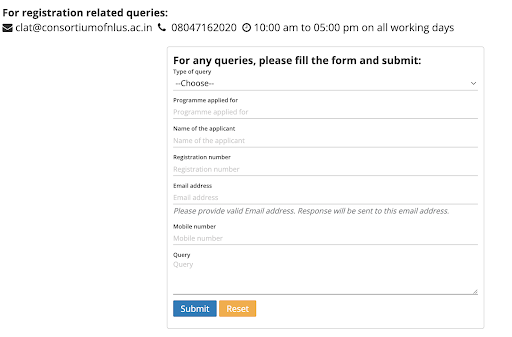
Candidates facing issues related to CLAT registration, application form submission, admit card download, result, or counselling process can contact the Consortium of National Law Universities through its official helpdesk.
However, candidates should make sure that they fill out the CLAT 2027 Application Form on time, as most official websites crash due to heavy traffic in the last few days.