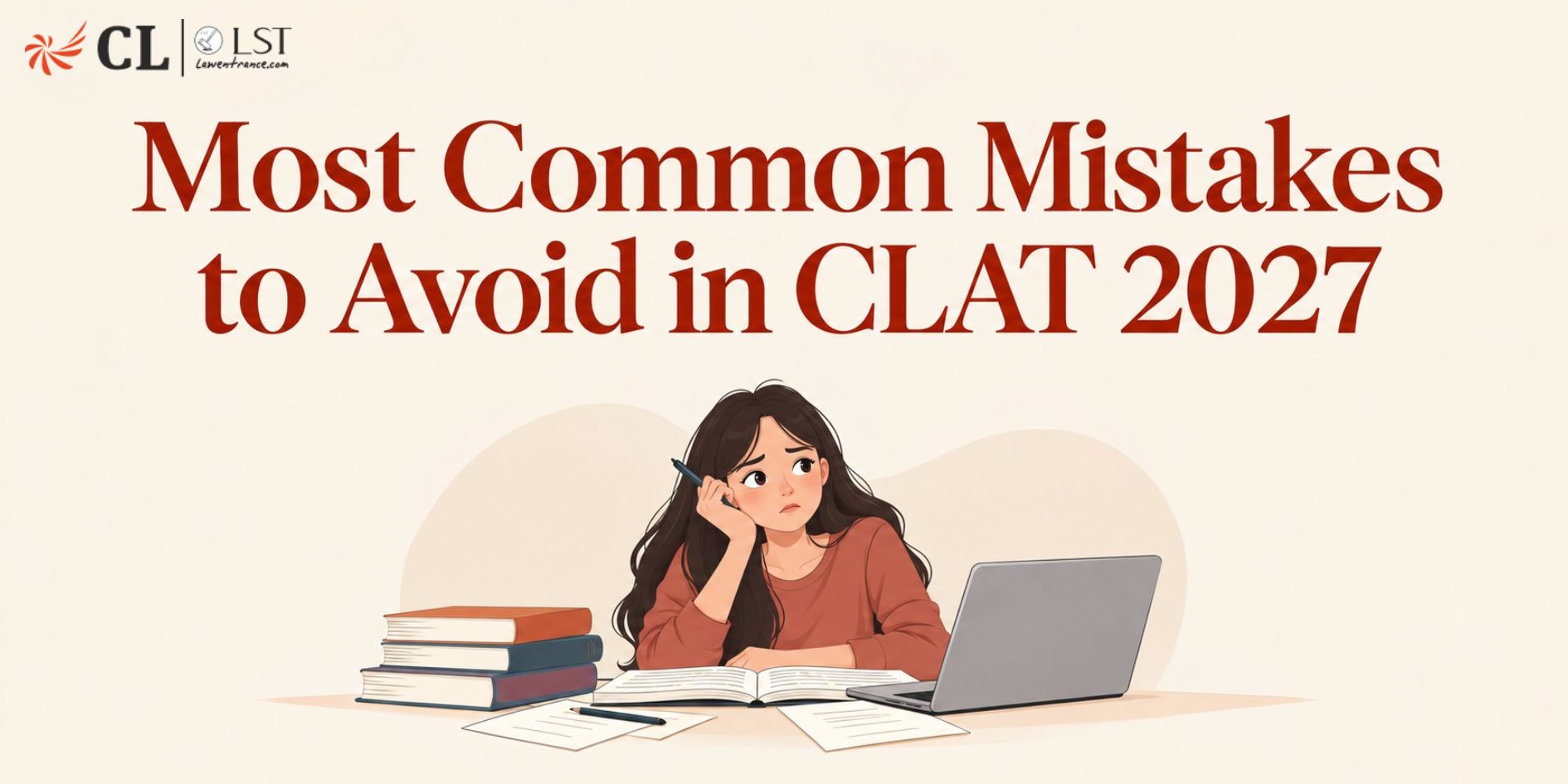
Most Common Mistakes to Avoid in CLAT 2027

Preparing for CLAT 2027 is not just about completing the syllabus or spending long hours studying. Students also need the right approach to practice, revision, mock tests, and time management. Despite consistent effort, some students may find that their performance does not improve as expected due to mistakes in their study strategy. These mistakes can often be identified and corrected through regular self-evaluation. This guide covers the most common mistakes to avoid in CLAT 2027 preparation and practical ways to correct them.
Table of Contents
Common CLAT 2027 Preparation Mistakes
1. Not Understanding the Latest CLAT Syllabus and Exam Pattern
The Mistake
Starting preparation without understanding the latest syllabus and exam pattern can lead to an unstructured approach. Students may also use outdated resources or spend time preparing topics that are not relevant to the examination.
Why It Happens
Students are often eager to start solving questions and may overlook the importance of understanding the examination requirements first.
How to Avoid It
- Go through the CLAT 2027 exam details, syllabus, and exam pattern before starting preparation.
- Understand the five sections, question format, and marking scheme.
- Use the CLAT Syllabus 2027 as a checklist throughout preparation.
- Make sure your study material is aligned with the latest syllabus.
2. Preparing Without a Structured Study Plan
The Mistake
Studying without clear daily or weekly targets can make preparation inconsistent. Students may spend more time on familiar topics while postponing weaker areas.
Why It Happens
Without a fixed routine, students often study according to their mood or preference rather than their preparation needs.
How to Avoid It
- Set realistic daily and weekly targets.
- Divide study time across all five sections.
- Give additional time to weaker areas without ignoring stronger ones.
- Include reading, Current Affairs, practice, revision, and mock tests in the schedule.
- Review your progress regularly and adjust the plan when required.
3. Ignoring Current Affairs and Reading Practice
The Mistake
Leaving Current Affairs and reading practice until the final months can make preparation difficult and increase the revision burden.
Why It Happens
Students may prioritise question-solving and assume that Current Affairs can be covered quickly towards the end.
How to Avoid It
- Read a reliable newspaper or Current Affairs source regularly.
- Focus on understanding important events and their context.
- Make short notes and revise them periodically.
- Practice reading passages regularly to improve reading speed, comprehension and accuracy.
- Avoid depending on multiple Current Affairs sources.
4. Taking Mock Tests Without Analysing Them
The Mistake
Taking one mock after another without analyzing performance limits the benefit of mock practice.
Why It Happens
Students often focus on their mock score or the number of tests completed instead of understanding why they made mistakes.
How to Avoid It
After every mock:
- Analyze incorrect and unattempted questions.
- Identify questions that took too much time.
- Compare section-wise accuracy and attempts.
- Note questions answered through guesswork.
- Record repeated mistakes in an error log.
- Practise weak areas before taking the next mock.
Use CLAT Mock Tests as a cycle of Take → Analyze → Correct → Practice → Retest, rather than simply measuring your score.
5. Ignoring Previous Years’ CLAT Question Papers
The Mistake
Relying only on mock tests without solving previous-year question papers can limit your understanding of actual CLAT questions.
Why It Happens
Students sometimes treat PYQs as optional practice instead of using them to understand question patterns and passages.
How to Avoid It
- Solve recent CLAT Previous Year Question Papers regularly.
- Attempt them under timed conditions.
- Analyze the questions after completing each paper.
- Identify recurring question types and difficult areas.
- Track your time and accuracy.
- Record mistakes and revisit them during revision.
6. Spending Too Much Time on Difficult Questions
The Mistake
Spending too long on a difficult question or passage can leave insufficient time for easier questions later in the paper.
Why It Happens
Students may feel reluctant to leave a question after already spending time on it or may try to solve every question in sequence.
How to Avoid It
- Practise passages under timed conditions.
- Track which questions or passages take the most time.
- Learn to move on when a question is taking too long.
- Mark difficult questions and return to them later if time permits.
- Test different time-management approaches during mocks.
- Finalise your approach only after testing it across multiple papers.
7. Changing the Preparation Strategy Too Frequently
The Mistake
Frequently changing the study plan, section order, or attempt strategy can make preparation inconsistent.
Why It Happens
A low mock score or one difficult paper can make students doubt a strategy that may simply require more practice.
How to Avoid It
- Test a strategy across multiple mocks before changing it.
- Compare accuracy, attempts, and time taken.
- Identify consistent patterns rather than reacting to one result.
- Make one change at a time.
- Give the revised strategy enough time to evaluate its effectiveness.
- Avoid trying an untested strategy close to the exam.
How to Improve Your CLAT 2027 Preparation
Regular practice is important for CLAT, but students also need to review their performance and work on areas that need improvement. Tracking mistakes, analyzing mocks, and retesting weak areas can make preparation more focused.
Maintain an Error Log
An error log helps students understand why they made mistakes and identify patterns in their performance. Record mistakes after mocks, sectional tests, and practice sessions.
| Error Log Entry | Sample Record |
| Question/Topic | Logical Reasoning – Inference |
| Mistake Made | Incorrect interpretation |
| Why It Happened | Rushed through the passage |
| Correct Approach | Identify the conclusion before evaluating the options |
| Next Step | Practice similar questions |
Focus on recurring mistakes rather than recording every incorrect answer. This makes the error log more useful during revision.
Analyze Your Mock Performance
A mock score alone does not show where your preparation needs improvement. Analyze each test to understand your accuracy, time management, and approach to different question types.
After every mock, check:
- Which questions were incorrect?
- Which questions were guessed?
- Which questions took too much time?
- Which section had the lowest accuracy?
- Which mistakes have been repeated?
- What should be practised before the next mock?
Practice and Retest Weak Areas
Once you identify a weak topic or recurring mistake, practise similar questions and test yourself again. This helps you determine whether the problem has been corrected or needs further practice.
Follow this cycle throughout your preparation:
Identify → Understand → Practice → Retest
Conclusion
Avoiding mistakes is an important part of effective CLAT 2027 preparation. Students should regularly review their study routine, mock performance, and practice approach to identify what needs improvement.
A structured plan, consistent practice and analysis of mistakes can make preparation more focused. Instead of constantly changing strategies, students should identify mistakes, learn from them and avoid repeating them as they continue their preparation.
Check CL-LST Coaching Programs –
Wishing you all the best!
Team CL!
Frequently Asked Questions
Q: How can I avoid common mistakes in CLAT 2027 preparation?
A: Students can avoid common CLAT mistakes by following the latest syllabus, maintaining a structured study plan, practising regularly, analyzing mock tests, solving PYQs, and reviewing recurring errors.
Q: Why is analyzing CLAT mock tests important?
A: Mock analysis helps students identify incorrect answers, time-consuming questions, weak sections and recurring mistakes. It also helps them decide what to practise before taking the next mock.
Q: Should I solve previous years’ CLAT question papers?
A: Yes. PYQs help students understand question framing, passage types and the difficulty level of the examination. They should be used along with regular practice and mock tests.
Q: How can I improve my time management for CLAT 2027?
A: Practise passages, sectional tests, and full-length papers under timed conditions. Track where you spend too much time and test different approaches during mocks.
Q: Should I change my CLAT preparation strategy after every mock?
A: No. One mock result should not determine your entire strategy. Compare performance across multiple mocks and make changes when a consistent pattern appears.
Author

Popular Posts
MH-CET Law 2025 Cutoff(5-Year)Out: Check Past Year Trends, & More
By CL LST Team
27 May 2025 12538
CLAT 2026 Question Paper (Updated) – Download CLAT 2026 Question Paper PDF
By CL LST Team
09 Dec 2025 9962
![MH-CET Law 2025 Result OUT! [Direct Link to Score card]](https://www.lawentrance.com/blogs/wp-content/uploads/2025/06/ChatGPT-Image-Jun-5-2025-04_52_35-PM.png)
MH-CET Law 2025 Result OUT! [Direct Link to Score card]
By CL LST Team
05 Jun 2025 9223
MH CET Law Reservation Policy
By CL LST Team
31 Mar 2025 8150
Latest Posts
Most Common Mistakes to Avoid in CLAT 2027
By CL LST Team
05 Oct 2026 18

Beyond the Books: The Lively Dialogue Between Law and Sociology
By CL LST Team
01 Oct 2026 50
CLAT 2027 English Language Important Topics
By CL LST Team
01 Oct 2026 41

Participating NLUs for CLAT 2027: Complete List of Law Universities
By CL LST Team
01 Oct 2026 62