CLAT UG Syllabus 2027: Download PDF + Complete Section-Wise Breakdown
CLAT UG Syllabus 2027: Planning to appear for CLAT 2027? Before you start with books, mock tests, or coaching classes, the most important step is understanding the CLAT syllabus thoroughly. In a highly competitive exam like CLAT, knowing exactly what to study and what to skip can make a huge difference in your preparation.
This guide gives you a complete breakdown of the CLAT UG 2027 syllabus, section by section. From key topics to the kind of skills each section tests, it will help you understand what the exam actually demands and how to prepare with better clarity and direction.
Table of Contents
What is CLAT?
The Common Law Admission Test (CLAT) is a national-level entrance exam conducted by the Consortium of National Law Universities (NLUs). It is the primary entrance exam for admission to 5-year integrated law programmes offered by participating National Law Universities (NLUs) and other affiliated institutions.
CLAT is held once a year in December, in offline (pen-and-paper) mode.
| Feature | Details |
| Conducting Body | Consortium of National Law Universities |
| Exam Mode | Offline (Pen and Paper) |
| Duration | 2 Hours (120 Minutes) |
| Total Questions | 120 |
| Marking Scheme | +1 for correct / −0.25 for incorrect |
| Unattempted Questions | No penalty |
| Question Type | Passage-based MCQs |
CLAT UG Syllabus 2027: Subjects Overview
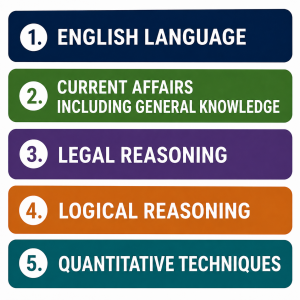
The CLAT UG syllabus consists of 5 subjects:
Also Check: CLAT 2027 Detailed Syllabus
CLAT 2027 Marks Distribution
| Subject | No. of Questions | Weightage |
| English Language | 22-26 | 20% |
| Current Affairs (incl. GK) | 28-32 | 25% |
| Legal Reasoning | 28-32 | 25% |
| Logical Reasoning | 22-26 | 20% |
| Quantitative Techniques | 10-14 | 10% |
| Total | 120 | 100% |
Section 1: English Language
The English section is entirely passage-based. You get a passage of around 450 words, drawn from editorials, literary writing, or policy documents, followed by 5-7 questions. There are no grammar fill-ups, no vocabulary lists, no sentence correction questions.
| Topic | Key Areas |
| Reading Comprehension | Main idea, theme, purpose of the passage |
| Inference-Based Questions | Conclusions that logically follow from the passage |
| Summarisation | Picking the most accurate summary from given options |
| Contextual Vocabulary | Meaning of words/phrases in the context of the passage |
| Tone and Viewpoint | Author’s attitude, argument, and perspective |
| Paragraph Structure | Relationship between sentences and ideas |
What this section really tests: Reading speed + comprehension accuracy. A student who reads analytically every day will consistently outperform one who doesn’t — regardless of how strong their English grammar is.
Preparation tip: Read one editorial daily from The Hindu or Indian Express. After each piece, ask yourself – what is the main argument? What assumptions is the author making? This habit will transform your performance in this section.
Check CL – LST Coaching Programs – CLAT Coaching 2027 | CLAT Online Coaching 2027
Section 2: Current Affairs Including General Knowledge
The highest-weightage section alongside Legal Reasoning. Passages come from news articles and journalistic sources. The questions test your awareness of current and historically significant events, and your ability to engage with a passage about them.
This section has two components: Static GK and Current Affairs.
Static GK Topics
| Topic | Key Areas |
| Constitution of India | Fundamental Rights, Directive Principles, important articles, amendment procedure |
| Indian Political System | Parliament, Judiciary, Executive, federal structure, Centre-State relations |
| Indian History | Freedom movement, major historical events, important figures |
| Geography | Physical, political, and economic geography of India and the world |
| Indian Economy | Key concepts, sectors, flagship government schemes |
| Science & Technology | Basic concepts, important discoveries and inventions |
| Awards & Institutions | National and international awards, important bodies and organisations |
Current Affairs Topics
| Topic | Key Areas |
| National Politics | Government policies, important bills, political developments |
| International Relations | Bilateral ties, treaties, global organisations (UN, WTO, IMF, etc.) |
| Economy & Finance | Union Budget, GDP, inflation, RBI policy, economic indices |
| Legal Developments | Supreme Court and High Court judgments, constitutional amendments, new laws |
| Government Schemes | Central and state schemes, their purpose and legal backing |
| Environment & Climate | Key summits, agreements, environmental issues |
| Science & Space | ISRO missions, national and global technology milestones |
| Sports | National and international championships, awards |
| Books & Notable Personalities | Recent publications, important public figures |
What this section really tests: Background knowledge that makes passage reading faster and more accurate. A student who has been tracking news for 6 months will read a passage on a GST ruling or a bilateral summit far faster than someone encountering the topic cold.
Preparation tip: Start a national newspaper from day one of your preparation, not the last two months. Maintain brief notes on major events, especially legal developments and government schemes, as these frequently overlap with Legal Reasoning passages.
Section 3: Legal Reasoning
This is the section where most CLAT ranks are won or lost. Passages present legal scenarios or fact situations. The questions ask you to identify the rule given in the passage and apply it to different sets of facts.
The Consortium is explicit: no prior legal knowledge is required. The passage is the law. Your job is to read the rule, understand it, and apply it, regardless of what you think you know.
| Topic | Key Areas |
| Law of Contract | Offer, acceptance, consideration, breach, void and voidable agreements |
| Law of Torts | Negligence, strict liability, nuisance, defamation, vicarious liability |
| Constitutional Law | Fundamental rights, directive principles, separation of powers, judicial review |
| Criminal Law | Mens rea, actus reus, offences, defences, culpable homicide vs. murder |
| Family Law | Marriage, divorce, maintenance, inheritance across personal laws |
| Property Law | Ownership, possession, transfer of property |
| Law of Evidence | Admissibility, burden of proof, presumptions, dying declarations |
| Public Policy & Moral Philosophy | Application of ethical principles to legal scenarios (increasingly common) |
| Legal Maxims | Common Latin maxims and their application in context |
What this section really tests: The ability to apply a given rule to a new fact situation — mechanically and accurately. Students who try to answer from general legal knowledge, rather than from what the passage says, consistently lose marks here.
Preparation tip: Practice the rule → scenario → apply → answer method every single day. Read Supreme Court judgment summaries and legal news columns so that legal language feels familiar by exam day.
Section 4: Logical Reasoning
Short passages followed by questions that test your ability to analyse the argument the author is making. You need to identify conclusions, examine what supports them, and answer questions about what strengthens, weakens, or follows from the reasoning.
| Topic | Key Areas |
| Identifying the Conclusion | What is the author ultimately claiming? |
| Identifying Premises | What evidence or reasoning supports the conclusion? |
| Strengthening an Argument | Which option makes the conclusion more likely to be true? |
| Weakening an Argument | Which option makes the conclusion less likely to be true? |
| Identifying Assumptions | What unstated premise is the argument relying on? |
| Drawing Inferences | What must follow from what the passage says? |
| Flaw in Reasoning | What error in logic does the author make? |
| Parallel Reasoning | Which other argument uses the same logical structure? |
| Analogies and Relationships | Identifying similar patterns across different situations |
| Contradictions | Spotting inconsistencies in the argument |
What this section really tests: Structured thinking and argument analysis, not common sense. Students who answer from gut instinct rather than from the argument structure lose marks at a predictable rate.
Preparation tip: For each question, follow this three-step process: identify the conclusion, identify the premises, then answer. Practice 10–15 passages daily and track which question types you consistently get wrong. Focused practice on weak areas always outperforms general practice spread across everything.
Section 5: Quantitative Techniques
Numerical information presented in text, tables, or graphs, followed by questions requiring Class 10 level maths. This is the only section that is not purely prose-based.
| Topic | Key Areas |
| Ratios & Proportions | Ratio, proportion, partnership |
| Percentages | Percentage calculations, percentage change |
| Profit & Loss | Profit, loss, discount, selling price |
| Basic Algebra | Simple equations and expressions |
| Time & Work | Work efficiency, pipes and cistern problems |
| Time, Speed & Distance | Problems on trains, boats, relative speed |
| Mensuration | Area, perimeter, volume of geometrical shapes |
| Averages | Mean, median, mode |
| Data Interpretation | Tables, bar graphs, pie charts, line graphs, caselets |
| Interest | Simple interest and compound interest |
What this section really tests: Careful reading of numerical data, not advanced maths. The maths is Class 10 level- the challenge is that data is packaged in ways that are easy to misread under time pressure.
Preparation tip: This is only 10% of the paper. Don’t let it eat time that belongs to Current Affairs or Legal Reasoning. Target 8-10 correct out of 10-14 attempted. Revise Class 10 maths if needed and practice data interpretation problems, specifically, the text-embedded format is unfamiliar to most students.
Final Word
The CLAT UG syllabus is well-defined and has been consistent for years. What separates toppers from the rest isn’t access to better material; it’s preparation that is genuinely aligned with what the exam tests.
Start early. Stay consistent with current affairs. Practice Legal Reasoning every single day. Build reading speed through real reading. And allocate your time in proportion to the weightage, not in proportion to what you find comfortable.
Frequently Asked Questions
Q: What is the CLAT UG syllabus for 2027?
A: The CLAT UG syllabus for 2027 includes five sections: English Language, Current Affairs including General Knowledge, Legal Reasoning, Logical Reasoning, and Quantitative Techniques.
Q: Has the CLAT 2027 syllabus changed?
A: As of now, no revised syllabus has been officially released. Students should continue preparing based on the current 5-section, passage-based CLAT pattern unless the Consortium announces any update.
Q: Which section carries the highest weightage in CLAT UG?
A: Current Affairs including General Knowledge and Legal Reasoning, usually carry the highest weightage, with around 25% each in the paper pattern.
Q: Is Quantitative Techniques difficult in CLAT?
A: Quantitative Techniques in CLAT is based on Class 10 level maths and usually tests basic numerical concepts through tables, graphs, and data-based questions.
Q: Is the CLAT syllabus the same for all students?
A: Yes, the same CLAT UG syllabus applies to all candidates appearing for the undergraduate exam, regardless of their board or stream.
Author

Popular Posts
MH-CET Law 2025 Cutoff(5-Year)Out: Check Past Year Trends, & More
By CL LST Team
27 May 2025 11389
![MH-CET Law 2025 Result OUT! [Direct Link to Score card]](https://www.lawentrance.com/blogs/wp-content/uploads/2025/06/ChatGPT-Image-Jun-5-2025-04_52_35-PM.png)
MH-CET Law 2025 Result OUT! [Direct Link to Score card]
By CL LST Team
05 Jun 2025 8962
CLAT 2026 Question Paper (Updated) – Download CLAT 2026 Question Paper PDF
By CL LST Team
09 Dec 2025 7870

CLAT 2025 UG Admission for NRIs & NRI-Sponsored Seats in 13 NLUs – Apply Soon!
By CL LST Team
19 May 2025 7611
Latest Posts
How to Cover CLAT GK Backlog in the Last 6 Months?
By CL LST Team
06 Jun 2026 28
Is CLAT Only for English Medium Students?
By CL LST Team
06 Jun 2026 24
CLAT Last 5 Years Topic-Wise Analysis (2022-2026): Complete Guide for CLAT Aspirants
By CL LST Team
01 Jun 2026 92
CLAT 2027 Mock Test Strategy: The Only Guide You Need
By CL LST Team
30 May 2026 77