How to Prepare for CLAT and AILET Together?

How to Prepare for CLAT and AILET Together? Every year, thousands of law aspirants prepare for CLAT exam with full dedication and then treat AILET as an afterthought. That is a mistake. If you are serious about getting into a top National Law University, preparing for both CLAT and AILET simultaneously is not just possible; it is the smartest thing you can do.
Here is everything you need to know.
Table of Contents
Why You Should Appear for Both CLAT and AILET?
NLU Delhi is not just another NLU. It consistently ranks alongside NLSIU Bangalore, NALSAR Hyderabad, and NUJS Kolkata, and AILET is the only way in. NLU Delhi does not accept CLAT scores, period.
Beyond prestige, AILET is your insurance policy. CLAT is unpredictable; cutoffs shift, paper difficulty varies, and one bad day can cost you a top seat. Appearing for AILET gives you two genuine shots at a top law school instead of one. For that alone, the extra effort is worth it.
Check CL-LST CLAT Preparation Programs – CLAT Online Coaching 2027
The Syllabus Overlap is Massive
Here’s what makes combined preparation genuinely feasible. AILET’s BA LLB exam has three sections: English Language, Current Affairs & GK, and Logical Reasoning. CLAT covers five: English, Current Affairs & GK, Legal Reasoning, Logical Reasoning, and Quantitative Techniques.
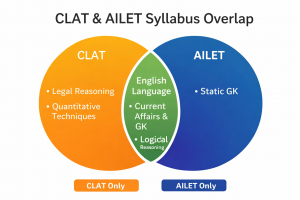
If you are preparing sincerely for CLAT, you are already covering the bulk of AILET’s syllabus. The additional effort required is far less than most aspirants assume.
What AILET Demands Beyond CLAT Preparation
The syllabus overlap is your biggest advantage, but AILET has a few areas where standard CLAT preparation simply isn’t enough. Ignore these, and you’ll feel the gap on exam day.
1. Logical Reasoning: The Section That Decides Your Rank
In CLAT, Logical Reasoning is one section among five. In AILET, it carries 70 out of 150 questions. That’s nearly half the paper.
The specific area that trips most aspirants is Analytical Reasoning, puzzles, linear and circular arrangements, seating, scheduling, and Venn diagram-based questions. CLAT’s Logical Reasoning is more reading-heavy and passage-based. AILET is pattern-heavy and speed-driven. Aspirants who don’t prepare for this distinction often find AILET’s Logical Reasoning section a rude surprise.
What to do: Practice Analytical Reasoning sets daily. Focus on arrangements, ordering puzzles, and set-based reasoning. Always practice under timed conditions; this section rewards speed as much as accuracy.
2. Static GK: The Gap Most Aspirants Don’t See Coming
CLAT’s Current Affairs section is largely passage-based and tests your awareness of recent events. AILET goes further; it places significant weight on Static GK covering history, geography, polity, science, major awards, and international organisations.
If you’ve only prepared for CLAT’s dynamic current affairs, AILET’s Static GK questions will catch you off guard.
What to do: Build a dedicated Static GK notes bank and revise it weekly. Key areas to cover: Indian Constitution basics, important historical events, geography fundamentals, and national and international awards. Don’t leave this for last-minute revision.
3. Legal Reasoning: Same Concept, Different Format
AILET doesn’t have a standalone Legal Aptitude section like CLAT does. Instead, legal reasoning is tested within the Logical Reasoning section through principle-fact-based questions. A legal principle is stated, a factual situation is given, and you must apply the principle to conclude. No prior legal knowledge is needed, but the format is more concise and logic-driven than what CLAT tests.
Aspirants who only practice CLAT-style legal reasoning sometimes find AILET’s version abrupt and unfamiliar.
What to do: Solve principle-fact-based legal reasoning questions separately as part of your practice routine. A few targeted sets each week is enough; you don’t need to overhaul your preparation, just sharpen the specific format.
How to Structure Your Combined Preparation?
Treat CLAT as your primary exam. Build AILET-specific skills on top, not as a parallel track.
| Preparation Area | Priority for CLAT | Additional Focus for AILET |
| English & RC | High | None – same effort covers both |
| Current Affairs | High | Add Static GK revision separately |
| Logical Reasoning | High | Extra practice on Analytical Reasoning |
| Legal Reasoning | High | Practice principle-fact based questions |
| Quantitative Techniques | Moderate | Not required for AILET |
One more thing on mock tests: take separate full-length mocks for both exams. AILET is a pen-and-paper offline exam; CLAT is conducted online. The experience of attempting both formats is different, and practicing accordingly helps you adapt on the actual exam day.
The Final Word
Preparing for CLAT and AILET together is not twice the work; it’s roughly 20-30% additional effort on top of a strong CLAT foundation. The syllabus overlap is too significant to ignore, and the reward, two real shots at India’s finest law schools, makes every bit of that extra effort worthwhile.
Treat CLAT as the foundation. Layer AILET-specific skills on top. Stay consistent with mocks for both. NLU Delhi has produced some of India’s sharpest legal minds; it deserves to be on every serious aspirant’s list.
FAQs
Q: Can I prepare for CLAT and AILET together?
A: Yes, you can prepare for CLAT and AILET together because both exams have a significant syllabus overlap. You only need some extra focus on AILET-specific areas like Analytical Reasoning and Static GK.
Q: Is AILET harder than CLAT?
A: AILET can feel tougher because it is more speed-based and has a strong focus on Logical Reasoning. CLAT, on the other hand, is more reading-intensive and passage-driven.
Q: What extra should I study for AILET apart from CLAT?
A: Along with CLAT preparation, focus on Analytical Reasoning, Static GK, and principle-fact based legal reasoning for AILET. These areas often require separate practice.
Q: Is Quantitative Techniques required for AILET?
A: No, Quantitative Techniques is not required for AILET. It is a CLAT-specific section, so AILET preparation focuses more on English, GK, and Logical Reasoning.
Q: Should I take separate mock tests for CLAT and AILET?
A: Yes, taking separate mocks is important because both exams have different patterns and test-taking formats. Practising both helps you adapt better on exam day.
Author

Popular Posts

MH-CET Law 2025 Cutoff(5-Year)Out: Check Past Year Trends, & More
By CL LST Team
27 May 2025 12498
CLAT 2026 Question Paper (Updated) – Download CLAT 2026 Question Paper PDF
By CL LST Team
09 Dec 2025 9656
![MH-CET Law 2025 Result OUT! [Direct Link to Score card]](https://www.lawentrance.com/blogs/wp-content/uploads/2025/06/ChatGPT-Image-Jun-5-2025-04_52_35-PM.png)
MH-CET Law 2025 Result OUT! [Direct Link to Score card]
By CL LST Team
05 Jun 2025 9186
MH CET Law Reservation Policy
By CL LST Team
31 Mar 2025 8098
Latest Posts

BA LLB vs BBA LLB: Differences, Career Scope, Salary & More
By CL LST Team
08 Sep 2026 70

AILET 2027 Preparation in 90 Days: Study Plan, Strategy & Tips
By CL LST Team
05 Sep 2026 75
How to Manage CLAT 2028 Preparation in Class 11: A Practical Guide
By CL LST Team
02 Sep 2026 90

SLAT Exam Centres 2027: Complete List of Test Cities
By CL LST Team
27 Aug 2026 87