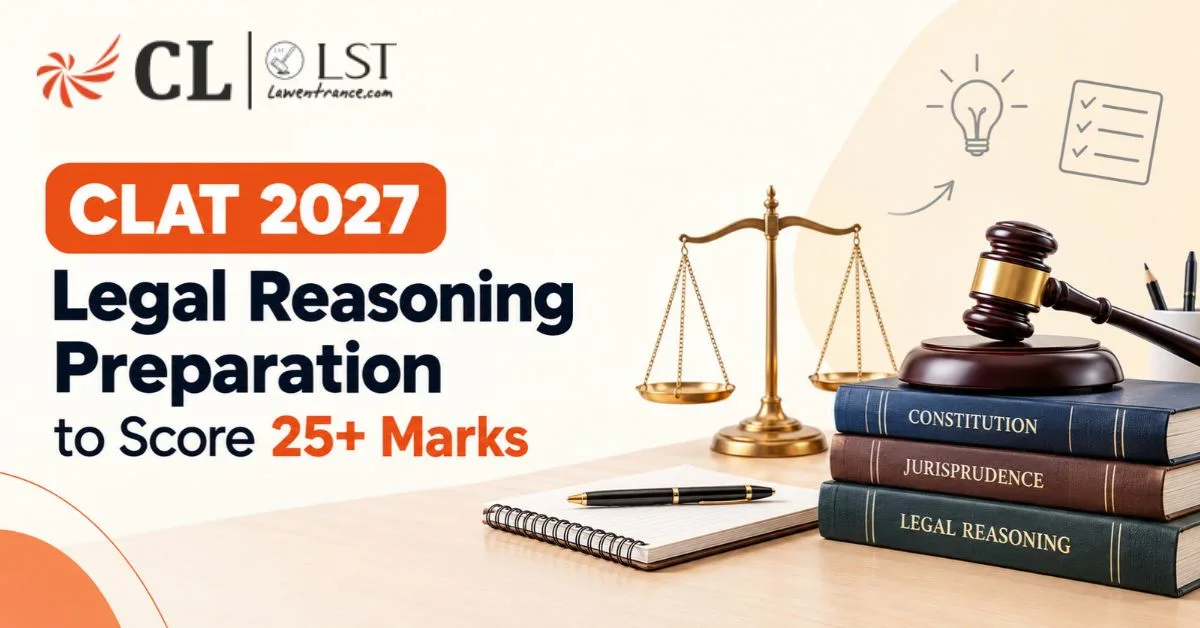
CLAT 2027 Legal Reasoning Preparation Strategy to Score 25+ Marks

CLAT Legal Reasoning is one of the most decisive sections of the exam. With approximately 28-32 questions, this single section can be highly affecting in terms of your final score and rank. Though many students feel that it is tough, Legal Reasoning is actually one of the most predictable and high-scoring areas once you understand the patterns and logic behind the questions and the right way to practice.
The following guide is a structured roadmap that will help you score 25+ marks in the Legal Reasoning section of CLAT 2027. It includes in-depth analysis, preparation plans, common mistakes, and practical tips derived from PYQs and recent exam trends.
Table of Contents
What makes CLAT 2027 Legal Reasoning Important?
CLAT Legal Reasoning is not just one section among many; it’s a ranking differentiator.
A strong performance here compensates for moderate performance in the other reading-based sections, including English and Logical Reasoning.
Key reasons why CLAT aspirants must target 25+ marks:
- Weightage of nearly 25 percent of the paper
- Logical and predictable question structure
- No prior legal knowledge is necessary
Most students consistently score 25+ in mocks only because they follow a structured approach and focus heavily on concept clarity and application.
Understanding what the CLAT tests in legal reasoning
CLAT does not test one’s knowledge of legal facts or complicated laws. In contrast, it tests:
- Your ability to understand a principle (rule)
- Your ability to apply that principle to a factual situation
- Your ability to reason logically within the framework given
Broadly, Legal Reasoning passages are based on four different areas:
Negligence, nuisance, strict liability, vicarious liability, defamation, duty of care.
- Criminal Law
Mens rea, actus reus, types of offences, intention, preparation, attempt.
- Contract law
Offer, acceptance, consideration, breach, void agreements, capacity.
- Constitutional Law
Fundamental rights, equality, freedom of speech, reasonable restrictions, constitutional remedies.
These four subjects cover almost 80 percent of passages in official CLAT papers and Consortium sample papers.
CLAT 2027 Legal Reasoning Question Structure
Each passage usually contains:
- A legal principle
- one or more facts
- Four multiple-choice questions
- Questions based strictly on applying the principle to the facts
The central expectation is straightforward:
Use only what is provided in the passage. Do not rely on prior knowledge or assumptions.
Strategy to Score 25+ in CLAT 2027 Legal Reasoning
This section outlines a structured approach based on exam trends, competitor analysis, PYQs, and expert recommendations from top law-entrance faculty.
Establishing Clear Conceptual Frameworks
Even though the test does not directly test legal knowledge, conceptual familiarity improves both accuracy and speed. Students with a basic understanding of legal terms interpret passages faster.
Focus on:
- Basic definitions
- Intention-based concepts
- Key elements of offences
- Breach and liability patterns
- Importance bills
- landmark judgements
You are not required to memorize case laws or sections. Logical understanding of concepts is enough.
Apply the Principle–Fact–Application Method
This is the most reliable way to solve questions with high accuracy.
Step 1: Read the principle thoroughly.
Know all the conditions and exceptions. Pay close attention to words such as
- Shall
- Must
- Unless
- If and only if
- Provided that
Step 2: Read the facts once without overthinking
Identify actors, actions, and outcomes.
Step 3: Apply the principle exactly as written
Match each condition of the rule with the facts.
Step 4: Do not add any external assumptions
More than the mistakes, CLAT penalizes overthinking.
Master Passage Selection Strategy
Not all passages are created equal. Attack them in the following order to maximize efficiency:
- Torts
- Contracts
- Criminal Law
- Constitutional Law
Generally, Torts and Contracts passages are easiest and most scoring due to the clear principle-facts relationship.
Constitutional law passages are longer, interpretative, and require more careful reading. Attempt these later to avoid time pressure.
Practice 3 to 5 Legal Passages Daily
Daily consistency is better than weekly bulk practice.
Ideal structure:
- Choose one passage from each major topic
- Time yourself and try to do each question in no more than two minutes.
- Re-attempt the wrong questions on the same day
- Keep a log of any recurring errors
Practice Sources:
- CLAT PYQs (2010–2025)
- Consortium sample papers
- Good quality coaching materials
- High-quality mock tests only
Improve Reading Speed and Comprehension
Since the CLAT exam is reading-intensive, any improvement in reading speed will automatically enhance Legal Reasoning scores.
Technique:
-
- Daily editorials from leading newspapers
- Summarization exercise: Reduce a paragraph to one line.
- Timed reading (250–280 WPM target)
- Avoid subvocalization when reading passages.
Elimination Techniques: Improve the Accuracy
Eliminate logically when two options seem similar.
Eliminate choices that:
-
- Add additional information
- Extreme language is not supported by the principle
- Ignore exceptions
- Misapply the sequence of conditions
- Conflict directly with the principles given.
- With consistent use of elimination, accuracy increases dramatically.
Solve 3 to 5 Years of CLAT PYQs
Previous year papers are the closest representation of actual exam difficulty and structure.
Analyze each paper for:
- Recurring principle frameworks
- Sentence structures employed in principles
- Common pitfalls
- Common law subjects
The highest jump in accuracy is often recorded among students who do PYQs thoroughly.
Take 2 to 3 Full-Length Mock Tests per week
Mocks simulate pressure conditions and help build stamina for solving long passages.
After every mock:
- Identify incorrect questions
- Note whether the mistake came from misreading, time pressure, or principle confusion.
- Re-solve all wrong passages
- Track progress over time
- Mock analysis is more important than attempts at merely attempting mocks.
Common Mistakes to Avoid While Preparing CLAT Legal Reasoning
However, one should be wary of the following mistakes in an effort to consistently score above 25.
- Applying external legal knowledge rather than adhering to the provided principle
- Reading the passages too fast and skipping keywords.
- It focuses solely on the concept theory, rather than application-based practice.
- The principle does not ignore exceptions.
- Starting with the most difficult passage first
- Not analyzing mock mistakes
- Poor time management
- Avoiding PYQs due to perceived difficulty
- Overthinking factual scenarios
- Misinterpreting Conditional Statements
Each of these errors can be rectified with structured practice and conscious monitoring.
Check CL-LST Coaching Programs –
| CLAT Online Coaching | CLAT Test Series |
| CLAT Classroom Coaching | CLAT Crash Course |
CLAT Legal Reasoning – Additional Tips to Secure 25+ Marks
- Read the principle slowly and the facts quickly
- Follow strictly what the principle is stating.
- Employ test-taking strategies consistently.
- Keep track of common error patterns
First, try reading the easier passages. Maintain calm under timed conditions. Legal Reasoning rewards discipline, clarity, and structured practice more than pure intelligence. Conclusion Legal Reasoning in CLAT 2027 is a high-scoring section that can prove to be significantly instrumental in boosting one’s overall performance, provided one follows the right strategy. Scoring 25+ is achievable for every student with conceptual clarity, regular practice of application-based passages, and consistent mock analysis; one also needs to master the elimination technique and be familiar with PYQs.
Author

Popular Posts

MH-CET Law 2025 Cutoff(5-Year)Out: Check Past Year Trends, & More
By CL LST Team
27 May 2025 12529
CLAT 2026 Question Paper (Updated) – Download CLAT 2026 Question Paper PDF
By CL LST Team
09 Dec 2025 9914
![MH-CET Law 2025 Result OUT! [Direct Link to Score card]](https://www.lawentrance.com/blogs/wp-content/uploads/2025/06/ChatGPT-Image-Jun-5-2025-04_52_35-PM.png)
MH-CET Law 2025 Result OUT! [Direct Link to Score card]
By CL LST Team
05 Jun 2025 9213
MH CET Law Reservation Policy
By CL LST Team
31 Mar 2025 8136
Latest Posts

How to Score 25+ in CLAT 2027 Current Affairs and General Knowledge
By CL LST Team
23 Sep 2026 75
How to Score 20+ in English Language for CLAT 2027?
By CL LST Team
22 Sep 2026 46

CLAT Preparation Strategy for Repeaters & Droppers – Expert Tips & Study Plan
By CL LST Team
16 Sep 2026 193
Benefits of Solving CLAT Previous Years’ Question Papers
By CL LST Team
16 Sep 2026 69