
Beyond the Books: The Lively Dialogue Between Law and Sociology


A law that nobody follows and a law that everybody respects are, in formal terms, identical. Both are printed in the same statute book, share the same legislative language, and carry the same official sanction. Yet in practice they could not be more different. What accounts for this divergence between a rule’s textual force and its social effect? The answer lies less in the wording of the provision itself and more in the population it seeks to govern: their habits, their beliefs, and the structures of power within which they live. This is the point at which sociology enters legal study, not to contest the authority of law, but to examine the social conditions that determine whether that authority is realised in practice.
Table of Contents
The Living Law and the Law in Action
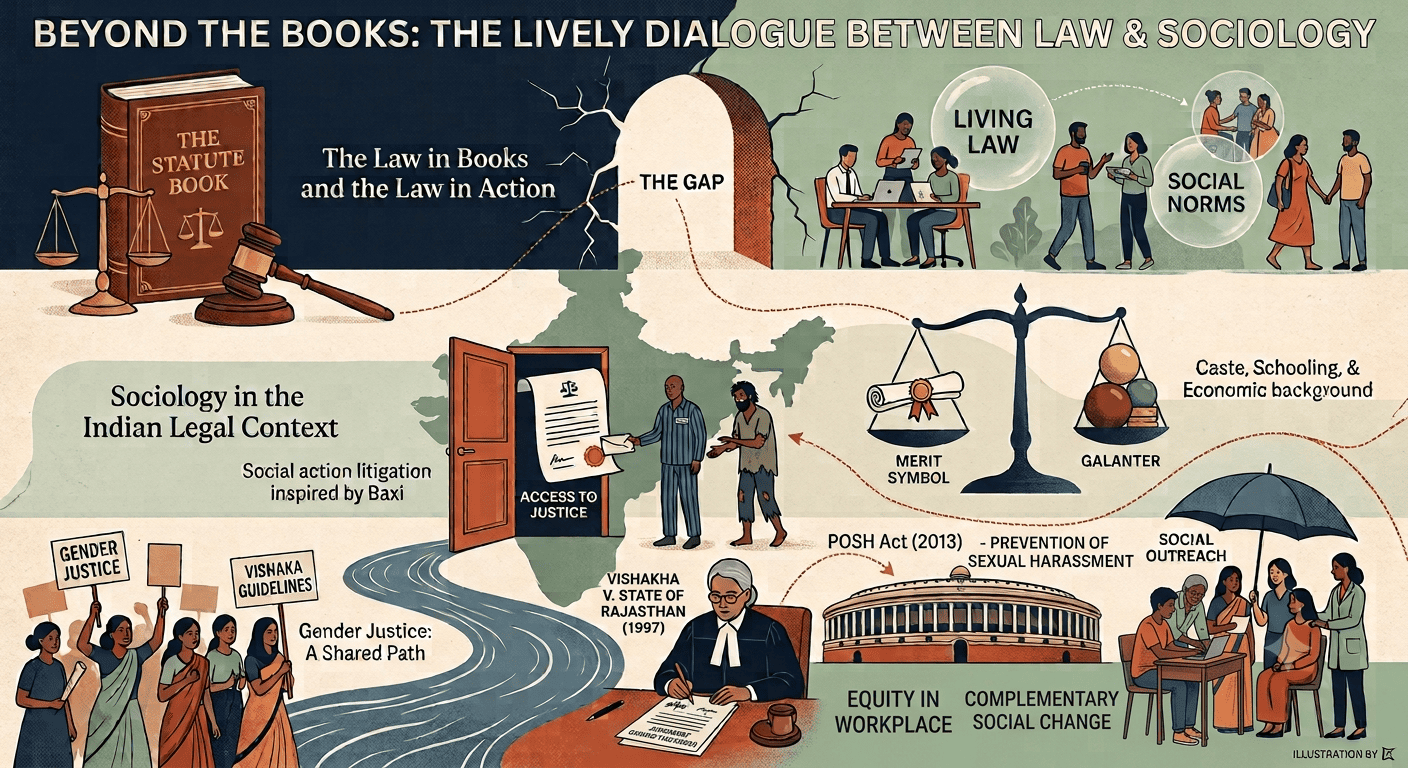
This concern is not a recent addition to legal scholarship. Writing in the early twentieth century, the jurist Eugen Ehrlich proposed a distinction that continues to structure sociological approaches to law. He separated positive law, the formal rules enunciated and enforced by the state, from what he termed the living law, the body of norms that actually governs everyday conduct, frequently independent of statutory sanction. For Ehrlich, the decisive centre of legal development lay not in legislatures or courts but within society itself (Ehrlich, 1936). This claim reoriented the study of law away from doctrinal exposition and toward empirical observation of how norms actually function.
Roscoe Pound extended this line of reasoning into what he called sociological jurisprudence. He identified the persistent disjunction between law in books, the law as formally enacted, and law in action, the law as it is applied, evaded, or reinterpreted in practice, and argued that this disjunction ought to be treated as a central object of legal inquiry rather than an incidental defect (Pound, 1910). Pound’s broader thesis was that law functions most effectively as an instrument of social engineering, adjudicating between competing individual, public, and social interests, rather than as a static body of command. This reframing situates jurisprudence as an applied social science, attentive to consequence rather than confined to internal legal logic.
Sociology in the Indian Legal Imagination
This theoretical inheritance was subsequently reworked within the Indian legal context to address concerns particular to the postcolonial state. Upendra Baxi, examining the emergence of social action litigation before the Indian Supreme Court, observed that while legal techniques may be transplanted across jurisdictions, the historical and social conditions that give those techniques their meaning cannot be transferred in the same manner (Baxi, 1985). The Court’s practice of treating informal communications from prisoners and bonded labourers as maintainable writ petitions was not, on this reading, a derivative borrowing from comparative public interest litigation, but a doctrinal response calibrated to a specifically Indian deficit in access to justice. The episode illustrates how judicial method can be recalibrated in light of sociological conditions, producing an instance of jurisprudence responsive to social reality rather than insulated from it.
Merit, Caste and the Question of Reservation
The jurisprudence surrounding reservation in India offers a further, and frequently contested, site for this analysis. Marc Galanter’s extended study of caste and law in India produced an influential reconsideration of the concept of merit as ordinarily deployed in constitutional discourse. Performance in a competitive examination, he argued, is not a neutral measure of individual capability but a composite outcome shaped by prior access to quality schooling, by the social and cultural capital that enables sustained preparation, and by relative freedom from the economic compulsion to earn (Galanter, 1984). This is not an argument against the principle of merit but a reformulation of it, situating individual achievement within its enabling social conditions. The reasoning has subsequently informed the Supreme Court’s own jurisprudence on affirmative action, indicating a degree of convergence between sociological analysis and constitutional interpretation on this question.
Gender Justice: Law and Society in Conversation
The development of Indian law on workplace sexual harassment provides a particularly clear instance of law and social movement operating in tandem. The governing guidelines did not originate in parliamentary legislation. They were formulated by the Supreme Court in Vishaka v. State of Rajasthan (1997) in response to the assault of a grassroots social worker in Rajasthan, targeted for her efforts to prevent a child marriage, through a combined reading of constitutional guarantees and India’s obligations under international human rights instruments. These judicially fashioned guidelines constituted the operative legal framework for over a decade prior to their eventual codification in the Sexual Harassment of Women at Workplace (Prevention, Prohibition and Redressal) Act, 2013, illustrating a sequential division of institutional labour between the judiciary and the legislature.
The Protection of Women from Domestic Violence Act, 2005 presents a more sobering variant of the same dynamic. Its substantive provisions are comprehensive, yet national survey data indicates that a considerable proportion of women who experience such violence do not access any formal mechanism of redress (International Institute for Population Sciences and ICF, 2021). This pattern cannot be attributed to deficiencies in statutory drafting. It is better explained by fear, economic dependence, and social stigma, conditions that lie outside the remedial capacity of legislation alone, and which require sustained institutional outreach and social change to accompany the formal legal guarantee (Agnes and D’Mello, 2015).
Sociology’s Place in Legal Practice and Education
These illustrations support a broader claim regarding legal pedagogy. Sociological training does not substitute for doctrinal competence in statute and precedent; it supplements it by equipping the practitioner to account for the social conditions under which legal provisions succeed or fail. A practitioner conversant with the Domestic Violence Act’s provisions serves a client adequately. A practitioner who additionally understands the social impediments to a survivor’s engagement with formal remedies is positioned to advise more effectively. The same logic extends to adjudication in family law, where social context materially informs judicial reasoning, and to policy formulation, where the objective is not merely the enactment of a provision but its actual uptake. Sociological literacy, on this account, refines rather than dilutes legal method.
Conclusion
The common thread linking Ehrlich, Pound, Baxi, and Galanter, despite their disparate national and disciplinary contexts, is the proposition that law cannot be adequately theorised in isolation from the society it governs. This proposition does not diminish the significance of doctrinal legal training; it situates that training within a more complete analytical frame, one in which legal reasoning is understood to draw upon social observation as much as upon precedent. A legal order that remains attentive to its social foundations tends, over time, to secure the continued confidence of those subject to it. This, in essence, constitutes the significance of the intersection between law and sociology: not a departure from legal thinking, but its necessary extension.
Author

Popular Posts

MH-CET Law 2025 Cutoff(5-Year)Out: Check Past Year Trends, & More
By CL LST Team
27 May 2025 12530

CLAT 2026 Question Paper (Updated) – Download CLAT 2026 Question Paper PDF
By CL LST Team
09 Dec 2025 9933
![MH-CET Law 2025 Result OUT! [Direct Link to Score card]](https://www.lawentrance.com/blogs/wp-content/uploads/2025/06/ChatGPT-Image-Jun-5-2025-04_52_35-PM.png)
MH-CET Law 2025 Result OUT! [Direct Link to Score card]
By CL LST Team
05 Jun 2025 9217

MH CET Law Reservation Policy
By CL LST Team
31 Mar 2025 8144
Latest Posts
Beyond the Books: The Lively Dialogue Between Law and Sociology
By CL LST Team
01 Oct 2026 13

CLAT 2027 English Language Important Topics
By CL LST Team
01 Oct 2026 13

Participating NLUs for CLAT 2027: Complete List of Law Universities
By CL LST Team
01 Oct 2026 30

CLAT 2027 Quantitative Techniques Important Topics
By CL LST Team
30 Sep 2026 33