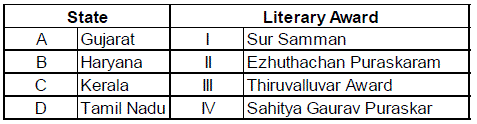
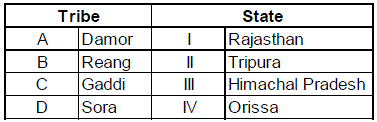
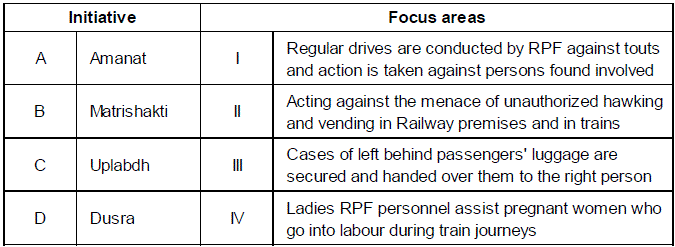
The AILET 2026 question paper followed the 150-question format across three sections and emphasized reading comprehension, logical reasoning, and smart time management. Analysing this paper is essential to understand the latest exam trends and difficulty level set by NLU Delhi.
Below, you can access the official AILET 2026 paper along with detailed expert solutions for clear concept understanding.
Read the given passage and answer the following questions by choosing the most appropriate
response.
I have still to be brother to a Prince, though I once came near to kinship with what might have been a
veritable King, and was promised the reversion of a Kingdom, army, law-courts, revenue and policy, all
complete. But, today, I greatly fear that my King is dead, and if I want a crown I must go and hunt it for
myself. The beginning of everything was in a railway train upon the road to Mhow from Ajmir. There had
been a deficit in the Budget, which necessitated travelling, not Second class, which is only half as dear as
First class, but by Intermediate, which is very awful indeed. There are no cushions in the Intermediate
class, and the population is either Intermediate, which is Eurasian, or native, which for a long night journey
is nasty; or Loafer, which is amusing though intoxicated. Intermediates do not patronize refreshment rooms.
They carry their food in bundles and pots, and buy sweets from the native sweet meat sellers, and drink the
roadside water. That is why in the hot weather Intermediates are taken out of the carriages dead, and in all
weathers are most properly looked down upon. My particular Intermediate happened to be empty till I reached
Nasirabad, when a huge gentleman in shirt sleeves entered, and, following the custom of Intermediates,
passed the time of day. He was a wanderer and a vagabond like myself, but with an educated taste for
alcohol. He told daring tales of things he had seen and done, of out of the way corners of the Empire into
which he had penetrated, and of adventures in which he risked his life for a few days’ food. “If India was filled
with men like you and me, not knowing more than the crows where they’d get their next day’s rations, it isn’t
seventy millions of revenue the land would be paying, it’s seven hundred million,” said he; and as I looked at
his mouth and chin I was disposed to agree with him. We talked politics, the politics of Loaferdom that sees
things from the underside where the lath and plaster is not smoothed off, and we talked postal arrangements
because my friend wanted to send a telegram back from the next station to Ajmir, which is the turning off
place from the Bombay to the Mhow line as you travel westward. He had the air of one who had seen
strange countries and stranger men, yet bore himself without vanity. There was a restless light in his eyes,
the sort that belongs to men who have lived too long without a fixed purpose. When he spoke of the Empire,
it was not with loyalty nor with bitterness, but with the detached amusement of one who has played his part
and lost interest in the game. His laughter came easily, though it seemed to echo from some remembered
hardship. It struck me then that his stories were less of adventure than of survival.
Q. 1 In the context of the passage, what does the word ‘vagabond’ mean?
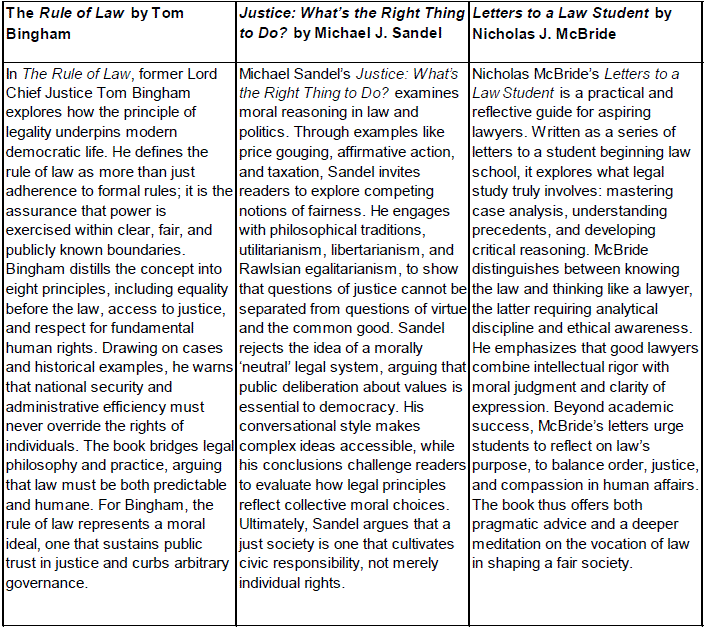
Q. 11 In the context of the above passage, consider the following Assertion (A) and Reason (R), and select the
appropriate option: Assertion (A): McBride believes that studying law is not merely about acquiring knowledge of legal rules. Reason (R): He argues that true legal understanding requires both analytical skill and ethical reflection.
Q. 15 According to the passage, which thinker most directly connects the study of law to practical skill and ethical
reflection for future practitioners?
Read the given passage and answer the following questions by choosing the most appropriate
response.
The advent of social media has dramatically transformed the way individuals consume and share information.
In earlier times, people largely depended on newspapers, radio, or television as their primary sources of
knowledge about the world. These were institutions that followed established editorial practices and factchecking
processes. With the rise of digital platforms, however, the traditional ‘gatekeepers’ of information
have been bypassed. Today, anyone with internet access can create content, express an opinion, or
broadcast an idea to a global audience within seconds. This shift has certainly democratized access and
given voice to communities and individuals who were often ignored by mainstream media. Yet, this
democratization comes with challenges. Alongside genuine voices, social media has also amplified
misinformation, rumours, and half-truths. Unlike traditional journalism, where accountability and verification
are built into the system, social media thrives on speed, virality, and emotion. A misleading headline, a
misinterpreted statistic, or even a doctored image can travel across the world before fact-checkers have
the chance to intervene. The consequences of such unchecked information can be serious, ranging from
the spread of fear and panic to the manipulation of public opinion. The impact of this transformation extends
beyond individual users to institutions and democracies. Political campaigns, corporate branding, and even
social movements are now shaped by algorithms that decide what people see and when they see it. These
algorithms prioritize engagement, often promoting content that provokes stronger emotional reactions rather
than balanced analysis. As a result, echo chambers form, online spaces where people are repeatedly
exposed to opinions that mirror their own, reinforcing biases and reducing openness to differing perspectives.
This has contributed to increasing polarization in societies across the world. Moreover, the competition for
attention has blurred the line between information and entertainment, leading to the rise of sensationalism
even in serious public discourse. The credibility of expertise too has been undermined, as opinions from
unverified sources are often placed on the same footing as evidence-based knowledge. In response, several
governments and technology companies are exploring ways to promote digital literacy, enhance transparency
in algorithms, and strengthen fact-checking collaborations. Ultimately, the challenge lies in balancing the
openness of digital spaces with mechanisms that ensure responsibility and trustworthiness in public
communication.
Q. 17 According to the passage, what is a key difference between traditional media and social media?
Q. 21 In the context of the above passage, consider the following Assertion (A) and Reason (R), and select the
appropriate option: Assertion (A): Social media allows anyone with internet access to broadcast ideas to a global audience. Reason (R): Traditional media platforms were exclusively available to trained journalists and editors.
Q. 22 Which of the following approaches is identified in the passage as a constructive response to the challenges
created by social media’s algorithm-driven information environment?
Read the given passage and answer the following questions by choosing the most appropriate
response.
The integration of Artificial Intelligence (AI) into law enforcement practices has sparked a global debate on
ethics, privacy, and accountability. From facial recognition systems in public spaces to predictive policing
algorithms, AI is transforming how crimes are detected and prevented. However, the benefits of efficiency
and data-driven decision-making are accompanied by concerns about fairness, bias, and the potential
erosion of civil liberties. One of the most controversial applications is predictive policing, which uses historical
crime data to forecast where crimes are likely to occur or who might commit them. Proponents argue that
this allows police to allocate resources more efficiently and reduce crime rates. However, critics warn that
such systems may reinforce existing societal biases. If past data reflect biased policing practices, such as
over-policing in marginalized communities, then the algorithm may perpetuate these injustices by
disproportionately targeting the same areas or groups. Facial Recognition Technology (FRT) is another AIdriven
tool that has gained traction. While it has proven useful in identifying suspects, it raises serious
concerns regarding surveillance and individual privacy. Studies have also shown that FRT is less accurate
in identifying people of colour and women, increasing the risk of false accusations and wrongful detentions.
The lack of transparency in how these systems operate further complicates the ethical landscape. Many AI
tools used in law enforcement are developed by private companies that treat their algorithms as proprietary,
meaning that even law enforcement officers may not fully understand how decisions are made by these AI
tools. This is often referred to as the ‘Black Box’ problem. This opaqueness undermines accountability,
making it difficult to challenge wrongful predictions or decisions in a court of law. As AI continues to evolve,
lawmakers and civil rights advocates are calling for stronger regulations to ensure that these technologies
are used responsibly. Proposals include mandatory auditing of algorithms, public disclosure of data sources,
and legal safeguards to protect against discrimination. Without such measures, the unchecked use of AI
could lead to a justice system that prioritizes efficiency over equity, ultimately compromising democratic
values and rule of law. While AI holds the promise of revolutionizing law enforcement, its application must
be guided by ethical frameworks that prioritize human rights, transparency, and fairness. Otherwise,
technology intended to protect society may end up harming the very individuals it seeks to serve.
Q. 24 What is the central concern raised in the passage regarding AI in law enforcement?
Q. 30 A government proposes a new Al-driven sentencing tool that assigns prison terms based on statistical
models trained on past sentencing data. The tool is designed to ensure consistency and eliminate human
error. Civil liberties groups oppose the tool, arguing it may encode past judicial biases. Which of the following
objections is most consistent with the concerns raised in the passage?
Read the given passage and answer the following questions by choosing the most appropriate
response.
In recent years, urban gardening has emerged as a widespread movement in cities across the globe.
Prompted by increasing concerns surrounding food security, sustainability, and mental well-being, urban
dwellers are reimagining their limited spaces including balconies, rooftops, alleyways, and windowsills, as
viable sites for food cultivation. At the heart of this shift lies the desire for fresh, organic produce, especially
in cities where access to pesticide-free food remains both costly and inconsistent. By growing their own
fruits, vegetables, and herbs, individuals can reduce their dependence on commercial supply chains, which
often entail extensive transportation, energy consumption, and synthetic chemical use. This not only
empowers consumers to take control of their dietary choices but also enhances awareness about nutrition,
food origins, and environmental impact. Urban gardening is also lauded for its ecological contributions.
Plants in urban environments combat the urban heat island effect, a condition where metropolitan areas
are significantly warmer than their rural counterparts due to concentrated human activity and infrastructure.
Vegetation improves air quality by absorbing carbon dioxide and releasing oxygen, while also managing
rainwater runoff and reducing pressure on often-overburdened drainage systems. Yet, the advantages of
urban gardening extend beyond the tangible. On a psychological level, cultivating plants offers therapeutic
benefits, including reduced stress, improved mood, and greater mindfulness. In the high-speed urban
landscape, tending to a plant provides a rare opportunity to engage with nature, fostering patience and a
sense of achievement. For many, these small pockets of greenery represent not just a practical solution
but an emotional and symbolic reclamation of space and agency. However, urban gardening is not without
its limitations. Scarcity of space, inadequate sunlight, and poor soil quality pose significant hurdles. In
response, gardeners have turned to innovative methods such as vertical farming, hydroponics, and compost
enrichment. Moreover, community gardens in shared spaces have flourished, enabling collective effort,
resource sharing, and social cohesion. While urban gardening may not supplant industrial agriculture, it
marks a meaningful shift toward more localized, responsible, and connected living, an act as much
philosophical as it is practical.
Q. 32 What is the ‘urban heat island effect’ mentioned in the passage?
Read the given passage and answer the following questions by choosing the most appropriate
response.
Democracy, often hailed as the most equitable form of governance, is a system where power ultimately
rests in the hands of the people. The word itself derives from the Greek words ‘demos’ meaning ‘people’
and ‘kratos’ meaning ‘power’ or ‘rule’. Democracy aims to provide equal political participation and protect
the individual freedoms of all citizens. However, while the ideal of democracy is simple, its practice is
frequently complex and fraught with challenges. At its core, democracy functions on the principle of majority
rule, yet it simultaneously guarantees the protection of minority rights.
This balance ensures that while the majority has the power to make decisions through voting, the fundamental
rights of minorities are not trampled upon. Such a system requires consistent vigilance and respect for the
rule of law. Without these, democracies can devolve into majoritarian tyranny or authoritarianism. The
practice of democracy is not merely limited to voting in elections. It encompasses freedom of speech, an
independent judiciary, free press, and protection of individual rights. These elements together create a
political environment where citizens can express dissent, hold leaders accountable, and participate actively
in decision-making. When any one component is weakened, the democratic process becomes vulnerable.
In recent times, democracies worldwide have grappled with new challenges. The rise of misinformation
and ‘fake news’ has eroded public trust in institutions and polarized societies. Social media platforms,
meant to facilitate communication, have sometimes amplified divisive narratives and falsehoods. This has
resulted in voter manipulation and a growing skepticism towards democratic processes. Literacy in media
and critical thinking is increasingly vital to safeguard democracy from such threats. Economic inequality
poses another significant challenge. While democracies promise equal rights politically, vast disparities in
wealth and opportunity undermine this ideal. Economic power often translates into political influence, skewing
representation and policy-making. This phenomenon raises questions about whether true democracy is
achievable without addressing socioeconomic inequalities. Furthermore, the involvement of citizens is
crucial. Democracy thrives when people are informed, engaged, and willing to participate beyond just casting
votes. Civic education and awareness campaigns play an essential role in nurturing responsible citizenship.
Apathetic or disengaged electorates weaken the democratic fabric, opening avenues for corruption and
authoritarian tendencies. In conclusion, democracy is a dynamic and evolving system that requires constant
effort to sustain. It is a system built on ideals of equality, freedom, and justice but challenged by human
complexities and contemporary issues. The survival of democracy depends on the collective responsibility
of governments and citizens to protect its pillars and ensure inclusive, fair governance.
Q. 44 In the context of the above passage consider the following statements, and select the appropriate option: Statement 1: Voting is the only element of democracy. Statement 2: Freedom of speech and an independent judiciary are essential for democracy.
Q. 52 Which country instituted proceedings against Israel before the International Court of Justice, alleging that
Israeli military action in Gaza violated the Genocide Convention?
Q. 55 India recently achieved a major breakthrough in gene therapy, marking the first successful indigenous clinical
trial for Hemophilia treatment. The trial was supported by Department of Biotechnology, Government of India
and done in which major hospital?
Q. 62 GRAP framework was introduced as an emergency response mechanism to combat the extreme air quality
and pollution conditions in Delhi-NCR. What does GRAP stand for:
Q. 63 Organic fisheries cluster focus on ecologically healthy fish farming system avoiding the use of harmful
chemicals, antibiotics and pesticides. This also ensures minimal environmental pollution and prevents damage
to aquatic ecosystems, contributing to sustainable fish production practices. A first-of-its-kind organic fisheries
cluster in India was launched in:
Q. 64 The nPROUD initiative, aimed at collection and safe disposal of unused and expired medicines in a scientific
manner, was recently launched by which State?
Q. 65 During the Republic Day parade, states showcase their culture, heritage, and achievements through vibrant
tableaux. Which state won the Best State Tableau prize for its creative and thematic presentation in 2025?
Q. 70 The India-AI Impact Summit 2026 will be the first-ever global AI summit to be hosted in a Global South nation.
Deliberations at the Summit will be organized around seven interconnected Chakras i.e. areas of multilateral
cooperation designed to channel collective energy towards holistic societal transformation. Which of the
following is NOT specifically noted as a chakra?
Q. 71 The National Quantum Mission (NQM), launched in 2023, aims to seed, nurture, and scale up scientific and
industrial R&D, and create a vibrant ecosystem in Quantum Technology (QT) in India. Four Thematic Hubs
(T-Hubs) were established under NQM to strengthen India's position as a global leader in quantum technology.
These hubs are located in:
Q. 72 Which of the following series was awarded the Best Series 2025 at the International India Film Awards (IIFA)
Digital Awards 2025, held in Jaipur?
Q. 73 In late 2024, Google announced development of state-of-the-art quantum chip, which is considered to be a
big step towards developing a large-scale, error-corrected quantum computer. The chip is named:
Q. 76 Recently, India announced its vision of MAHASAGAR, expanding its maritime engagement from a regional to
a global outlook, with particular focus on the Global South. This initiative seeks to promote security and
growth through cooperative partnerships with maritime and island states, strengthening defence, economic,
and developmental collaboration, and advancing humanitarian and capacity-building efforts. What does it
stand for?
Q. 78 Which 1971 study conducted at a major US University by Philip Zimbardo, often cited in discussions on
abuse of power and institutional accountability, did college students, randomly assigned contrasting social
roles within a simulated correctional environment, begin exhibiting extreme behaviours that revealed the
powerful influence of situational factors on human conduct and authority?
Q. 81 A company switches to a 4-day workweek and observes no productivity drop. Leaders claim the schedule is
efficient. Which assumption is needed to support the leaders' claim?
Q. 87 Every Mathematician is a Statistician. Some Statisticians are also Computer Scientists.
No Computer Scientist
is a Mathematician. Which of the following conclusion necessarily follows?
I. Some Statisticians are not Mathematicians.
II. All Statisticians are Computer Scientists.
III. Some Mathematicians are Computer Scientists.
For Questions 88-89: Research indicates that regular physical activity is crucial for maintaining overall health
and preventing severe diseases. Engaging in moderate exercise can improve overall health, enhance mood, and
boost immune function. Despite these benefits, many individuals remain sedentary due to a lack of motivation or
resources. Studies have shown that community programmes aimed at increasing physical activity, such as group
fitness classes and public parks, significantly enhance participation levels and improve community health.
Q. 88 Which of the following, if true, would most strengthen the argument presented above?
Q. 92 All Architects are Visionary. Some Visionary people are Designers. No Designer is a Lawyer. Which of the
following conclusion necessarily follows?
I. Some Visionary people are not Lawyers.
II. Some Architects are Designers.
III. All Designers are Visionary.
Q. 93 All Astronauts are Smokers. All Drivers Ski. Some Astronauts are Drivers. Kamlesh is an Astronaut.
I. Kamlesh Skis
II. Kamlesh does not Ski
III. Kamlesh is a Smoker
IV. Kamlesh is not a Smoker
V. Kamlesh is a Driver
VI. Kamlesh is not a Driver
Q. 95 All renewable energy plants are environment friendly.
Some solar plants are renewable energy plants.
No coal plant is environment friendly.
Which of the following conclusion necessarily follows?
I. Some solar plants are environment friendly.
II. No coal plant is a renewable energy plant.
III. Some coal plants are solar plants.
Q. 96 Online grocery stores in Delhi have reported a 50% increase in sales over the past year. Analysts attribute
this to the convenience of home delivery and competitive pricing. Which of the following must be assumed
for the analysts' conclusion to hold?
Q. 97 Some Birds are Flightless. All Sparrows are Birds. All Birds have Beaks. Which of the following conclusions
necessarily follow?
I. All Sparrow have Beaks.
II. Some Flightless are Sparrows.
III. Some Beaked are Flightless.
Q. 98 All Contracts are Agreements. Some Agreements are Void. No Void is Enforceable. Which of the following
conclusions necessarily follow?
I. Some Contracts are not Enforceable.
II. No Enforceable is Void.
III. Some Agreements are not Enforceable.
Q. 99 All Scripts are Code. Some Code is Optimized. No Optimized code is Verbose. Which of the following
conclusions necessarily follow?
I. Some Scripts are Verbose.
II. Some Code is not Verbose.
III. All Scripts are Optimized.
Q. 100 A study shows students in schools with longer library hours read more books. Policymakers conclude
extending hours will increase reading everywhere. Which assumption underlies this conclusion?
Q. 103 An econometric study using difference-in-differences technique finds no significant employment effect from
a minimum-wage hike. Which evidence most strengthens this finding?
For Questions 104-105: Diversity may bring people to the same room, but inclusion ensures that every voice is
heard, valued, and allowed to shape the conversation. It demands that institutions go beyond representation to
transformation, to question who holds the power, who defines norms, and whose stories remain unheard. It is the
process of turning the promise of democracy into practice, one case, one reform, and one act of courage at a
time.
Q. 104 Based on the passage above, which of the following can be most logically inferred?
Q. 106 Principle: A driver is responsible for controlling their vehicle and avoiding harm to pedestrians, unless the
pedestrian acted recklessly or unlawfully. Facts: A driver hits a pedestrian who suddenly runs across the road outside a crosswalk without looking.
The driver was obeying all traffic rules.
Q. 110 Principle: A public official must avoid conflicts of interest that could undermine public trust, even if no actual
wrongdoing occurs. Facts: A city mayor awards a major construction contract to a company owned by her cousin. She discloses
the relationship publicly and follows all procurement procedures.
Apply the principle and select the most appropriate option:
Q. 112 University examination department is attempting to devise a schedule for the end term examination. The
subjects are Constitutional Law, Taxation, Regulatory Governance, Sociology and Criminal Law. The following
considerations must be kept in mind.
I. Regulatory Governance must follow Criminal Law
II. Sociology and Criminal Law cannot immediately precede or follow each other
III. Regulatory Governance must immediately precede Taxation
IV. Constitutional Law cannot be the first or the last exam
V. Examinations for all subject are held once.
Which of the following schedule is a valid schedule?
Q. 115 Introducing cycling lanes reduces minor collisions in a district. Which of the following more strongly supports
the causal link between these events?
Q. 116 In a study on workplace productivity, employees with flexible schedules reported higher job satisfaction.
However, productivity levels between flexible and fixed schedule employees were almost the same. Which
of the following conclusion can be logically drawn?
Q. 117 Public health officials warn that air pollution increases the risk of respiratory disease. A recent drop in pollution
levels coincided with a fall in new respiratory disease cases. Which of the following, if true, most strengthens
the officials' warning?
Q. 118 The government announced subsidies for electric vehicles (EVs) to encourage consumers to buy more
EVs. However, sales of EVs remained stagnant. Which of the following, if true, would best explain the
outcome?
Q. 126 All Emails are Messages. Some Messages are Urgent. No Urgent Messages are Casual. Which of the
following conclusions necessarily follows?
I. Some Emails are Casual.
II. Some Messages are not Casual.
III. All Urgent Messages are Emails.
Q. 127 Principle: Negligence may be inferred when the incident causing harm is of a kind that ordinarily does not
occur without someone's negligence, the instrumentality or control that caused the harm was under the
defendant's management, and the plaintiff did not contribute to the harm. Fact: Anita visits a hospital for a routine check-up. While waiting in the lobby, a large ceiling fan suddenly
detaches and falls, injuring her shoulder. The hospital authorities claim that the fan had been regularly
serviced and no defect was known before the accident.
Applying only the given principle to the fact, is the hospital liable? Select the most appropriate option:
Q. 128 A city plans to replace cash bus fares with a QR-only system to reduce revenue leakage. Critics argue
ridership among the elderly will drop. Which assumption best supports the critics?
Q. 129 Excessive sugar-sweetened beverage intake correlates with higher cavity rates. A claim is made that such
beverages cause cavities. Which, if true, most weakens the causal claim?
Q. 131 All scientists hold Ph.D. Some engineers are scientists. No scientist works without access to the laboratory.
Which of the following are the most. appropriate conclusions?
I. All scientists work in the laboratory.
II. Some engineers have Ph.D.
III. All engineers are scientists.
For Questions 132-133:
The phenomenon of urbanisation has led to significant changes in social structures and community interactions.
As people migrate from rural areas to cities, they often face challenges such as increased cost of living, social
isolation, and a disconnection from their traditional support networks. Studies indicate that urban residents tend to
form new types of relationships, often relying on informal networks and community groups to adapt to their new
environments. While urban living can foster innovation and economic opportunities, it can also contribute to feelings
of loneliness and a decline in mental health if social connections are not established.
Q. 132 If the above is true, which of the following conclusions is most contradicted by it?
Q. 134 All teachers are creative people. All creative people are sensitive. No insensitive person is a teacher. Which
of the following conclusions necessarily follows?
I. Some sensitive people are teachers.
II. All sensitive people are teachers.
III. No teacher is insensitive.
Q. 135 Anamika complains that in her debate club, she is always assigned to the less-preferred side of the argument,
while another member consistently gets the more popular choice. Which of the following, if true, supports
Anamika's complaint?
Q. 139 Shopkeeper are Big. Some Big persons violate night curfew. All who violate night curfew are fined. Anil is Big.
Examine the following statements:
I. Anil is a Shopkeeper
II. Anil may violate a night curfew
III. Anil will definitely violate night curfew
IV. If Anil is a shopkeeper, he will get fined
V. Anil will definitely get fined
Q. 140 Some Cyclists are Marathoners. All Marathoners train rigorously. Some Trainees are Amateurs. Which of
the following conclusion necessarily follows?
Q. 141 The city's new bike-sharing programme has been widely adopted, reducing traffic congestion and promoting
healthy lifestyles. Which of the following is a necessary assumption?
Q. 142 Researchers claim that planting trees in urban areas can significantly reduce summer temperatures. Which
of the following, if true, most strengthens this claim?
Q. 143 Principle: A person who keeps or engages with hazardous or inherently dangerous substances or activities
is liable for any or all harm resulting from their escape or impact, regardless of the precautions taken, unless
the harm was caused by an act of God, act of a third party, or consent of the victim.
Fact: Seema owns a perfume factory that lawfully stores large quantities of chemicals used in fragrance
production. One night, a sudden lightning strike causes a fire, leading to the release of toxic fumes that harm
nearby residents. Seema had complied with all safety requirements and had fireproof storage facilities in
place.
Applying only the given principle to the fact, is Seema liable? Select the most appropriate option:
Q. 144 All Samosas are Delicious. Some Delicious is Spicy. No Spicy is Steamed. Which of the following conclusions
necessarily follows?
I. Some Samosas are Spicy.
II. Some Delicious are not Steamed.
III. No Samosa is Steamed.
Q. 145 All Engineers know Mathematics. Some Coders are Engineers. No Artist is an Engineer. Which of the
following conclusions necessarily follows?
I. Some Coders know Mathematics.
II. Some Mathematicians can also Code.
III. Some Artists know Mathematics.
Q. 146 All renewable energy sources reduce carbon emissions.
Some renewable energy sources are expensive to
install. Solar energy is a renewable energy resource.
Consider the following conclusions:
I. Solar energy reduces carbon emissions.
II. All expensive energy sources are renewable.
III. Some renewable energy resources are not expensive.
Q. 148 All Parathas are Sustainable. Some Sustainable are Cost-Effective. All Cost-Effective are Popular. Consider
the following conclusions necessarily follows:
I. Some Popular are Parathas.
II. All Parathas are Popular.
III. Some sustainable are Popular.
Q. 149 Roorkee City plans to replace all diesel buses with electric buses within five years to reduce air pollution.
Officials claim this will significantly improve air quality and reduce respiratory illnesses. Which of the following
is an assumption made by the officials?
Q. 150 Many schools have introduced digital textbooks, arguing that they are more cost-effective and environmentally
friendly than printed books. Which of the following, if true, would most weaken this argument?