CLAT vs SLAT: Key Differences, Colleges, and Difficulty

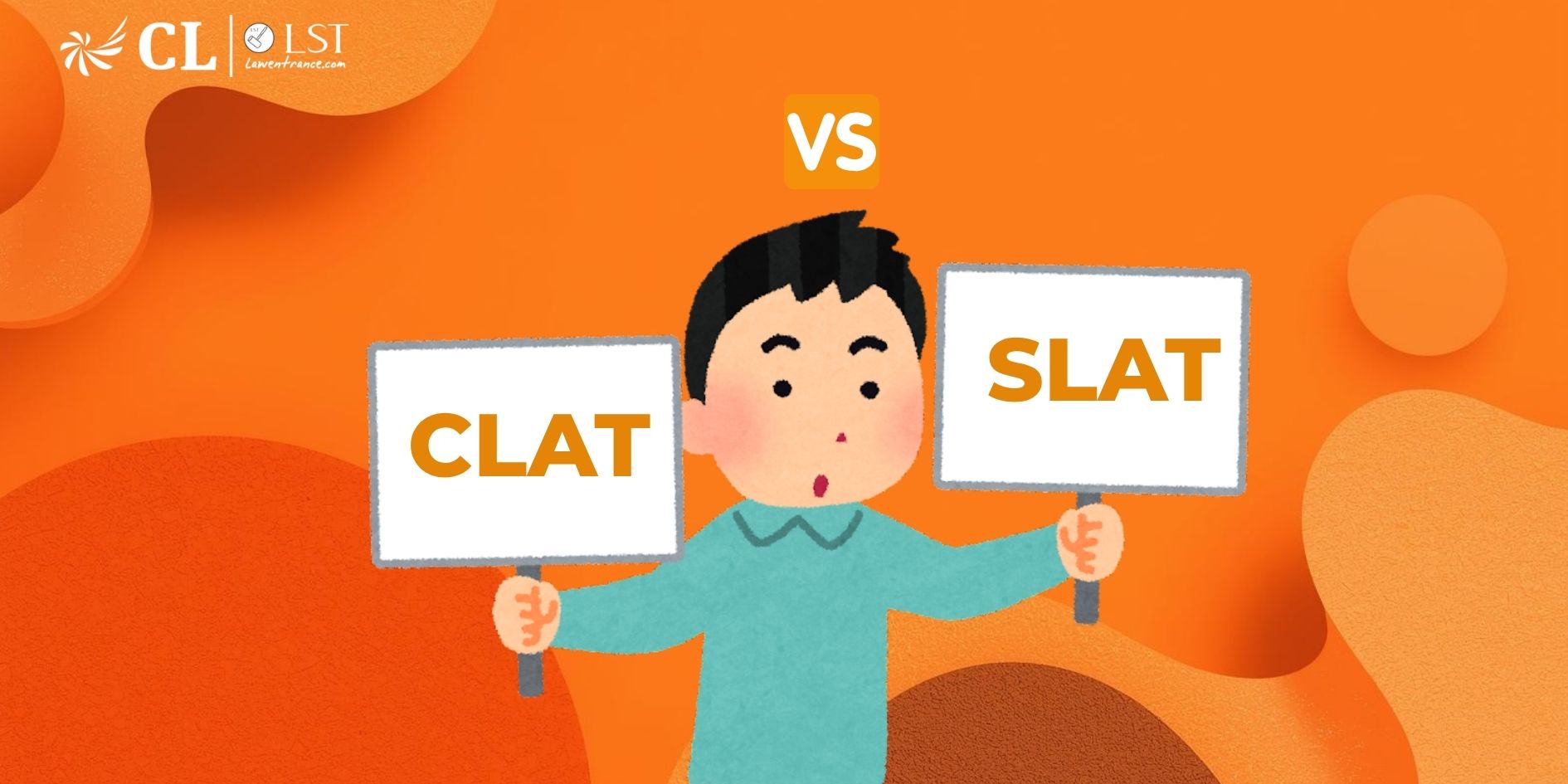
Most aspiring law candidates have heard about CLAT and SLAT s two of India’s most prominent law entrance exams. While both serve as gateways to top law colleges, they differ significantly in terms of exam structure, accepting institutions, and career outcomes. Differences between them can be classified into sections such as:
- Exam Pattern
- Colleges
- Reach of the Exam
- Difficulty Level
- Selection Process
This blog will help you understand the differences between the two law entrance tests. Learn about CLAT vs SLAT based on their test patterns, accepted colleges, courses offered, and more.
Table of Contents
CLAT vs SLAT: Exam Pattern
The table below compares and contrasts the CLAT and SLAT examination patterns.
| Features | CLAT | SLAT |
| Exam mode | Offline (Pen-and-Paper) | Online (Computer Based Test) |
| Test Language | English | English |
| Total no. of questions | 120 | 60 |
| Test Duration | 120 minutes | 60 minutes |
| Marking Scheme | +1 for every correct answer, -0.25 for each incorrect answer. | No negative marking |
| Sections |
|
|
| Types of Questions | Multiple choice questions | Multiple choice questions |
CLAT vs SLAT Application Fees
The following table compares the application fees for CLAT and SLAT.
- For all categories of applicants, the SLAT registration cost is 2250/-, which is non-refundable. You must additionally pay the program registration fee for each program in addition to the registration fee. The program registration cost is INR 1000/- (non-refundable and non-transferable).
- The CLAT Registration cost, on the other hand, varies according to the candidate’s category. It is Rs. 4000/- for general category applicants. It is 3500/- for reserve category applicants.
CLAT vs SLAT: Participating colleges
Both CLAT and SLAT have different colleges participating. The list is given below.
SLAT 2027: Colleges and Seats
The colleges that accept SLAT results are listed, along with the seat intake for each.
| Symbiosis Law School | Total Number of Seats |
| SLS Pune | 420 |
| SLS Nagpur | 240 |
| SLS Hyderabad | 240 |
| SLS Noida | 300 |
CLAT 2027: Colleges
CLAT scores are accepted by 26 NLUs (National Law Universities) in India for admission into UG and PG law courses. The seat intake for each university is different. Candidates should check the website of the NLU for more information. In no particular order, given below is a list of 26 NLUs that accept CLAT scores.
|
NLU Name |
|
| National Law School of India University, Bengaluru (NLSIU) | Damodaram Sanjivayya National Law University, Visakhapatnam (DSNLU) |
| National Academy of Legal Studies & Research University of Law, Hyderabad (NALSAR) | Tamil Nadu National Law University, Tiruchirappalli (TNNLU) |
| National Law Institute University, Bhopal (NLIU) | Maharashtra National Law University, Mumbai (MNLU Mumbai) |
| The West Bengal National University of Juridical Sciences, Kolkata (WBNUJS) | Maharashtra National Law University, Nagpur (MNLU Nagpur) |
| National Law University, Jodhpur (NLUJ) | Maharashtra National Law University, Aurangabad (MNLU Aurangabad) |
| Hidayatullah National Law University, Raipur (HNLU) | Himachal Pradesh National Law University, Shimla (HPNLU) |
| Gujarat National Law University, Gandhinagar (GNLU) | Dharmashastra National Law University, Jabalpur (MPDNLU) |
| Dr. Ram Manohar Lohiya National Law University, Lucknow (RMLNLU) | Dr. B.R. Ambedkar National Law University, Sonipat (DBRANLU) |
| Rajiv Gandhi National University of Law, Patiala (RGNUL) | National Law University Tripura, Agartala |
| Chanakya National Law University, Patna (CNLU) | Gujarat National Law University, Silvassa |
| National University of Advanced Legal Studies, Kochi (NUALS) | Ramaiah Purushottam National Law University, Prayagraj (RPNLU) |
| National Law University, Cuttack, Odisha (NLUO) | National Law University, Meghalaya |
| National University of Study & Research in Law, Ranchi (NUSRL) | National Law University & Judicial Academy, Guwahati, Assam (NLUJAA) |
Check the official website of the Consortium.
Which comes out tougher in CLAT vs SLAT?
A candidate’s first thought before appearing for the entrance exam is which one will be hardest to crack. When comparing competition levels, CLAT is significantly more difficult than SLAT in terms of the number of candidates competing for available seats. CLAT attracts a far larger pool of applicants nationally, making the competition for seats at top NLUs extremely intense.
When comparing the difficulty level of questions, CLAT offers harder reading comprehension and legal reasoning questions structured entirely around passage-based formats. SLAT, on the other hand, features direct objective-type questions with no negative marking, making it relatively more accessible in terms of question format. To make it simpler for applicants, CLAT has been updated by increasing the number of comprehensive types of questions.
Conclusion
Both CLAT and SLAT are strong law entrance exams but serve different purposes. CLAT is the more competitive exam and opens doors to 26 NLUs across India, while SLAT is the gateway to the four prestigious Symbiosis Law Schools. Since the syllabi overlap significantly and the exams are held around the same time, most aspirants prepare for and appear in both; maximising their chances of securing a seat at a quality institution. Identify your target colleges, choose the right exam, and prepare with intent.
Frequently Asked Questions
- What is the difference between CLAT and SLAT?
CLAT is a national-level law entrance exam for admission to participating National Law Universities (NLUs), while SLAT is conducted by Symbiosis International (Deemed University) for admission to its undergraduate law programmes. The two exams differ in participating colleges, exam pattern, eligibility, syllabus, selection process, and difficulty level. - Which is better, CLAT or SLAT?
CLAT is generally the better choice for students targeting NLUs and a wider range of law colleges, while SLAT is a strong option for students specifically interested in Symbiosis law schools. Students can take both exams to keep more undergraduate law admission options open. - Is CLAT harder than SLAT?
CLAT and SLAT have different exam patterns and levels of competition. CLAT is generally considered more competitive because it provides admission to leading NLUs, while SLAT focuses on admission to Symbiosis law institutes. The perceived difficulty can vary from year to year. - Can I prepare for CLAT and SLAT together?
Yes, students can prepare for CLAT and SLAT together because both exams test areas such as English, logical reasoning, legal reasoning, and general knowledge/current affairs. However, candidates should also prepare specifically for the differences in their exam patterns and question formats. - What is the difference between the CLAT and SLAT exam patterns?
CLAT and SLAT have different exam structures, sections, question distribution, duration, and marking schemes. Students should check the latest official exam pattern for the respective admission year because these details can change. - Which colleges accept CLAT and SLAT scores?
CLAT scores are primarily used for admission to participating NLUs and other institutions that accept CLAT scores, while SLAT scores are used for undergraduate law admissions at participating Symbiosis law schools. The list of participating institutions may change each year. - What is the eligibility for CLAT and SLAT?
CLAT and SLAT have their own eligibility requirements for undergraduate law programmes, including educational qualifications and other admission conditions. Candidates should check the latest official eligibility criteria before applying.
Author

Popular Posts

MH-CET Law 2025 Cutoff(5-Year)Out: Check Past Year Trends, & More
By CL LST Team
27 May 2025 12542
CLAT 2026 Question Paper (Updated) – Download CLAT 2026 Question Paper PDF
By CL LST Team
09 Dec 2025 10010
![MH-CET Law 2025 Result OUT! [Direct Link to Score card]](https://www.lawentrance.com/blogs/wp-content/uploads/2025/06/ChatGPT-Image-Jun-5-2025-04_52_35-PM.png)
MH-CET Law 2025 Result OUT! [Direct Link to Score card]
By CL LST Team
05 Jun 2025 9227

MH CET Law Reservation Policy
By CL LST Team
31 Mar 2025 8161
Latest Posts

CLAT 2028 Syllabus: Section-wise Topics and Proposed Changes
By CL LST Team
08 Oct 2026 41
AILET 2027 Marks vs Rank: Expected Rank for Your Score
By CL LST Team
06 Oct 2026 66

Most Common Mistakes to Avoid in CLAT 2027
By CL LST Team
05 Oct 2026 39

Beyond the Books: The Lively Dialogue Between Law and Sociology
By CL LST Team
01 Oct 2026 83