How Difficult Is It to Crack CLAT?

How difficult is it to crack CLAT? This is one of the most common questions among law aspirants before starting their preparation. The honest answer is that CLAT is competitive, but it is not impossible to crack if you prepare with the right strategy.
In this blog, we will break down the actual difficulty level of CLAT, section-wise challenges, competition level, and whether an average student can realistically crack it.
Table of Contents
The Numbers Tell the Real Story
Before anything else, look at this:
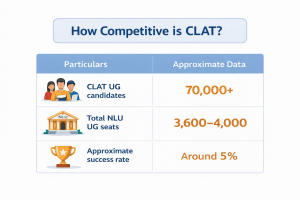
So yes, CLAT exam is one of the most competitive law entrance exams in India. But that does not mean the exam is conceptually very hard. In many cases, students struggle more because of time pressure, reading speed, accuracy, and lack of proper preparation than because of difficult concepts.
What Actually Makes CLAT Difficult?
CLAT is not difficult because of advanced concepts. It feels difficult because of the way the paper is designed.
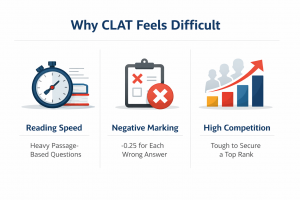
1. It is highly reading-intensive
The entire CLAT UG paper is largely passage-based. Whether it is English, Legal Reasoning, Current Affairs, Logical Reasoning, or even Quantitative Techniques, you need to read quickly, understand the passage, and answer under time pressure.
This is where many students struggle:
- slow reading speed
- weak comprehension
- spending too much time on one passage
2. Negative marking makes accuracy important
Each wrong answer costs 0.25 negative marks. So blindly attempting too many questions can actually reduce your score.
In CLAT, a smart attempt strategy matters a lot. For example, attempting fewer questions with higher accuracy is often more effective than attempting the entire paper carelessly.
3. Small mistakes can affect your rank heavily
Because the competition is so high, even a difference of 2-4 marks can push your rank up or down by hundreds or even thousands.
This is especially true for top NLUs, where the margin for error is very small.
Section-wise Difficulty Breakdown
| Section | Questions | Difficulty Level |
| CLAT English Language | 22-26 | Moderate |
| Current Affairs & GK | 28-32 | Moderate-High |
| CLAT Legal Reasoning | 28-32 | Easy-Moderate |
| CLAT Logical Reasoning | 22-26 | Moderate-High |
| Quantitative Techniques | 10-14 | Moderate |
The verdict: Legal Reasoning and Current Affairs are where most students lose or gain rank. Quantitative Techniques has the fewest questions, but is often where students waste the most time.
Can an Average Student Crack CLAT?
Yes, and this is important. CLAT does not test brilliance. It tests consistency, reading ability, and familiarity with the exam pattern. Many students who cracked top NLUs were not school toppers. What separated them was:
- Starting early.
- Taking CLAT Mock Tests regularly and analysing them deeply.
- Reading a newspaper daily – not for GK cramming, but to build reading speed and comprehension.
- Not wasting time on irrelevant material.
How Long Does CLAT Preparation Actually Take?
| Time Available | What It Usually Means |
| 12-18 months | Ideal for building a strong base and targeting top NLUs with consistent preparation. |
| 6-8 months | Enough time for a solid CLAT attempt; many students can aim for good NLUs with focused study. |
| 3-4 months | Possible for a decent score, but requires strict mock-based preparation and strong consistency. |
| 1-2 months | Very challenging; best suited for quick revision or students who already have a strong aptitude base. |
Check CL-LST CLAT Online Coaching | CLAT Crash Course
Important note
Preparation time alone does not decide your result.
A student who studies consistently for 4-6 focused hours daily, takes mocks seriously, and reviews mistakes properly can outperform someone who studies for longer hours without structure.
5 Habits of Students Who Crack CLAT
- They take mocks seriously, not just as practice but as diagnostic tools. Every mock is followed by a deep analysis of what went wrong and why.
- They read every day: The Hindu or Indian Express, not just for current affairs but to build the comprehension speed CLAT demands.
- They don’t skip Quantitative Techniques; most students ignore it because it has fewer questions, but those 13-17 marks can change your rank significantly.
- They attempt strategically; they know which sections to start with and when to skip a question rather than waste time on it.
- They start with previous year papers, understanding the actual pattern of questions is far more useful than generic preparation.
Conclusion
CLAT is definitely a competitive exam, but it is not impossible to crack. The difficulty level is less about tough concepts and more about handling pressure, reading quickly, and maintaining accuracy in a limited time. For most students, the real challenge is not the syllabus itself, but staying consistent with preparation, mock tests, and current affairs. With the right strategy and regular practice, even an average student can build a strong chance of scoring well in CLAT.
Author

Popular Posts

MH-CET Law 2025 Cutoff(5-Year)Out: Check Past Year Trends, & More
By CL LST Team
27 May 2025 12498
CLAT 2026 Question Paper (Updated) – Download CLAT 2026 Question Paper PDF
By CL LST Team
09 Dec 2025 9656
![MH-CET Law 2025 Result OUT! [Direct Link to Score card]](https://www.lawentrance.com/blogs/wp-content/uploads/2025/06/ChatGPT-Image-Jun-5-2025-04_52_35-PM.png)
MH-CET Law 2025 Result OUT! [Direct Link to Score card]
By CL LST Team
05 Jun 2025 9186

MH CET Law Reservation Policy
By CL LST Team
31 Mar 2025 8098
Latest Posts

BA LLB vs BBA LLB: Differences, Career Scope, Salary & More
By CL LST Team
08 Sep 2026 70

AILET 2027 Preparation in 90 Days: Study Plan, Strategy & Tips
By CL LST Team
05 Sep 2026 75

How to Manage CLAT 2028 Preparation in Class 11: A Practical Guide
By CL LST Team
02 Sep 2026 90

SLAT Exam Centres 2027: Complete List of Test Cities
By CL LST Team
27 Aug 2026 87